A Hybrid Machine Learning Framework for Water Quality Index Prediction Using Feature-Based Neural Network Initialization
Objective
This project develops a hybrid machine learning framework for water quality index prediction, utilizing a dataset of 3,276 samples with nine physicochemical parameters to classify water as potable or non-potable. After addressing class imbalance with SMOTE (Synthetic Minority Over-sampling Technique) and standardizing features, the framework implements two innovative architectures: the Adaptive Attention-Guided Hybrid Ensemble (AAGHE) , which combines an autoencoder with CatBoost (Categorical Boosting), ExtraTrees (Extremely Randomized Trees), and HistGradientBoosting (Histogram-based Gradient Boosting) classifiers alongside an attention-based meta-learner to achieve 99.33% accuracy; and the Dual-Transformer Cross-Fusion Network (DTCF-Net) , which uses parallel transformer blocks with cross-attention fusion to capture complex feature interactions, achieving 68.81% accuracy. The system includes a deployment-ready inference pipeline that generates actionable treatment suggestions based on parameter threshold violations, supporting water safety management, public health monitoring, and timely intervention through rigorous evaluation metrics.
Abstract
This
project presents an advanced machine learning framework for water potability
prediction aimed at supporting intelligent water quality monitoring and public
health management. The framework utilizes physicochemical water quality
indicators, including pH, Hardness, Solids, Chloramines, Sulfate, Conductivity,
Organic Carbon, Trihalomethanes, and Turbidity, to determine whether water is
safe for human consumption. A comprehensive preprocessing pipeline was
implemented, involving missing value handling, feature scaling, data balancing,
and train-test splitting to ensure robust model performance. The proposed
framework introduces a novel Adaptive Attention-Guided Hybrid Ensemble (AAGHE)
model that combines deep latent feature extraction through an Autoencoder with
multiple ensemble learners, including CatBoost, Extra Trees, and HistGradient
Boosting classifiers. An attention-guided neural meta-learner is employed to
intelligently fuse predictions from the base models, enhancing classification
accuracy and generalization capability. For comparative evaluation, a
Dual-Transformer Cross-Fusion Network (DTCF-Net) was also developed to capture
complex feature interactions using transformer-based architectures.
Experimental results demonstrate the superior performance of the proposed AAGHE
framework, achieving an accuracy of 99.33%, with precision, recall, and
F1-scores exceeding 99%, significantly outperforming the DTCF-Net model, which
achieved an accuracy of 68.81%. The trained models were saved for deployment and
real-time inference applications. By effectively modeling complex nonlinear
relationships among water quality parameters, the proposed framework provides a
reliable and scalable solution for automated water safety assessment. This
approach can assist environmental agencies, water treatment facilities, and
policymakers in ensuring safe drinking water, enabling proactive
decision-making, efficient resource management, and sustainable water quality
monitoring.
Keywords: Water Potability Prediction, Water Quality Assessment, Adaptive Attention-Guided Hybrid Ensemble (AAGHE), Autoencoder, CatBoost, Extra Trees, HistGradient Boosting, Deep Learning, Transformer Networks, DTCF-Net, Machine Learning, Environmental Monitoring, Public Health, Predictive Analytics.
NOTE: Without the concern of our team, please don't submit to the college. This Abstract varies based on student requirements.
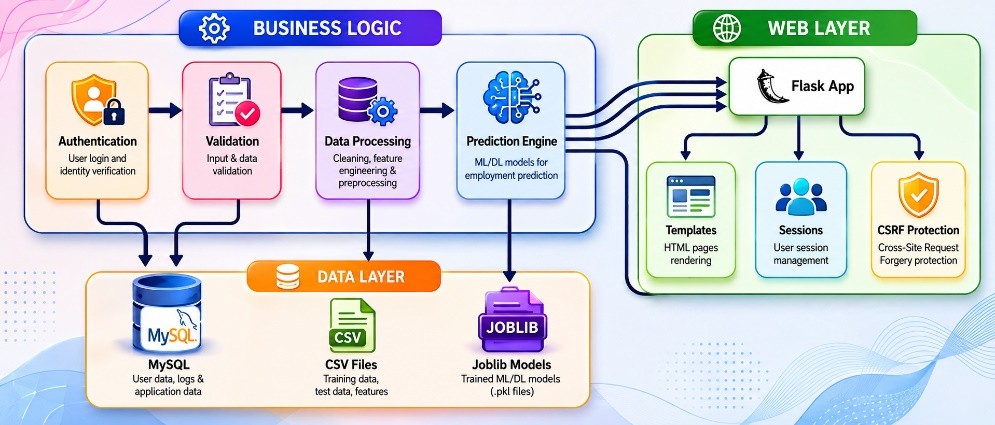
Block Diagram
Specifications
4.1 SOFTWARE REQUIREMENS
Operating System : Windows 7/8/10
Server side Script : HTML, CSS, Bootstrap & JS
Programming Language : Python
Libraries : Flask, Pandas, Sklearn, Numpy , Seaborn
IDE/Workbench : VSCODE
Server Deployment : Xampp Server
Database : MySQL
4.2 HARDWARE REQUIREMENTS
Processor - I3/Intel Processor
RAM - 8GB (min)
Hard Disk - 128 GB
Key Board - Standard Windows Keyboard
Mouse - Two or Three Button Mouse
Monitor - Any

Demo Video


Request for Video
 Paper Publishing
Request Call Back
Would you like to receive a free callback now?
Choose the best time for callback:
Leave your message and we will contact you as soon as possible

6-2-85/B, Old Maternity Hospital Road, Thyagaraja Nagar, Tirupati, Andhra Pradesh – 517501
+91 9030333433
+91 9393939065
0877-2261612

Disclaimer - Takeoff Edu Group Projects are not associated or affiliated with IEEE in any way. The IEEE Projects mentioned here are mentioned in the context of student projects, whose ideas are derived from IEEE publications, not projects of or by IEEE.

