A hybrid graphtemporal Deep learning framework for crop yield prediction using multisource satellite and Agronomy data
Objective
The objective of this project is to develop a deep learning-based system for accurate tomato leaf disease identification to assist in precision agriculture. The system aims to automate the disease detection process, overcoming the challenges of manual inspection, such as time consumption and subjectivity. By utilizing a tomato leaf disease dataset from Kaggle, the project applies image preprocessing, augmentation, feature extraction, and classification techniques to enhance disease recognition accuracy. The proposed system employs three advanced models: EfficientNetB0, Residual Dense Attention Network (RDAN), and Multi-Scale Inverted Residual Network (MSIRNet). EfficientNetB0 serves as a lightweight baseline, RDAN improves feature learning through residual dense connections and attention mechanisms, and MSIRNet captures disease patterns at multiple scales using inverted residual structures. The primary goal is to build an efficient, automated solution to identify tomato leaf diseases based on key features like color, texture, edge, and lesion patterns. This project aims to support farmers, researchers, and agricultural experts in timely and accurate disease management.
Abstract
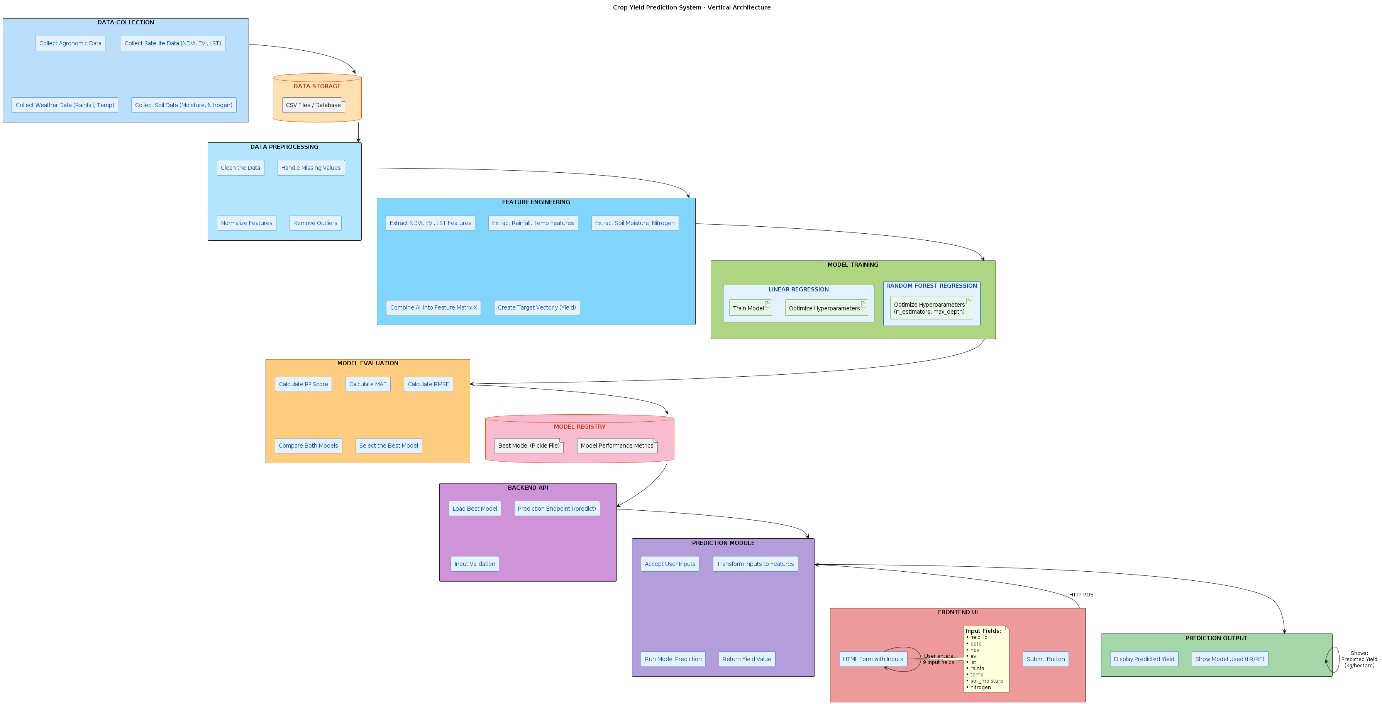
Crop yield prediction plays a pivotal role in modern agriculture by aiding farmers and stakeholders in making informed decisions about crop management and resource allocation. This study presents a machine learning-based approach to predict crop yield using multi-source synthetic agronomic and satellite data. The dataset comprises key variables such as field characteristics, land surface temperature (LST), soil moisture, rainfall, temperature, nitrogen levels, and vegetation indices (NDVI, EVI). Two machine learning algorithms, Linear Regression and Random Forest Regression, were employed to model the relationship between these factors and the predicted crop yield. The performance of both models was evaluated using metrics such as R² (Coefficient of Determination), MAE (Mean Absolute Error), and RMSE (Root Mean Square Error). The results show that Random Forest Regression outperforms Linear Regression, achieving a test R² of 96.35% and significantly lower error metrics. The Linear Regression model, while less accurate, demonstrated moderate predictive power with a test R² of 69.26%. The findings emphasize the potential of machine learning models in crop yield forecasting and their applications in precision agriculture, thereby contributing to more efficient farming practices and better resource management.
Keywords: Crop Yield Prediction, Machine Learning, Random Forest Regression, Linear Regression, Agronomic Data, Satellite Data, NDVI, EVI, R², MAE, RMSE, Precision Agriculture.
NOTE: Without the concern of our team, please don't submit to the college. This Abstract varies based on student requirements.
Block Diagram
Specifications
SOFTWARE REQUIREMENS
Operating System : Windows 7/8/10
Server side Script : HTML, CSS & JS
Programming Language : Python
Libraries : scikit-learn, pandas, numpy, matplotlib, seaborn, TensorFlow, Keras, Flask, SQLAlchemy.
IDE/Workbench : VSCode
Server Deployment : MYSQL
Database : MySQL
HARDWARE REQUIREMENTS
Processor - I3/Intel Processor
RAM - 8GB (min)
Hard Disk - 128 GB
Key Board - Standard Windows Keyboard
Mouse - Two or Three Button Mouse
Monitor - Any


 Paper Publishing

Request Call Back
Would you like to receive a free callback now?
Choose the best time for callback:
Leave your message and we will contact you as soon as possible

6-2-85/B, Old Maternity Hospital Road, Thyagaraja Nagar, Tirupati, Andhra Pradesh – 517501
+91 9030333433
+91 9393939065
0877-2261612

Disclaimer - Takeoff Edu Group Projects are not associated or affiliated with IEEE in any way. The IEEE Projects mentioned here are mentioned in the context of student projects, whose ideas are derived from IEEE publications, not projects of or by IEEE.

