A Hybrid Deep Learning Model for Network Intrusion Detection System Using Seq2Seq and ConvLSTM Subnets
Objective
The objective of this project is to develop an advanced Hybrid Deep Learning-based Network Intrusion Detection System (NIDS) that can efficiently detect and classify cyber threats in real-time. By combining Sequence to Sequence (Seq2Seq) and Convolutional Long Short-Term Memory (ConvLSTM) subnets with Convolutional Neural Networks (CNN), Long Short-Term Memory (LSTM) networks, Forward Neural Networks (FNN), and Explainable Artificial Intelligence (XAI) techniques, the goal is to enhance the detection of various network intrusions. The primary aim is to design a model capable of analyzing network traffic data for identifying and mitigating anomalies and cyber-attacks such as DDoS, malware, and data breaches. The system will ensure real-time threat detection, providing network administrators with actionable insights and improving security protocols.
Abstract
Network security has become a critical concern as the complexity and volume of cyber-attacks continue to rise, especially in environments with interconnected devices and systems. This project introduces a novel hybrid deep learning model for Network Intrusion Detection Systems (NIDS), which integrates Sequence to Sequence (Seq2Seq) architecture with Convolutional Long Short-Term Memory (ConvLSTM) subnets, Convolutional Neural Networks (CNN), Long Short-Term Memory (LSTM) networks, and Forward Neural Networks (FNN). The proposed hybrid model effectively combines the advantages of these architectures to detect and classify network intrusions by analyzing network traffic data for patterns indicative of malicious behavior.The Seq2Seq architecture is used to model temporal dependencies in network traffic, while the ConvLSTM network is applied to capture spatiotemporal features, enhancing the ability to detect complex attack patterns. Additionally, CNNs are used for feature extraction to capture high-level features from the data, which are then fed into FNNs for classification. The system incorporates Explainable Artificial Intelligence (XAI) using Local Interpretable Model-agnostic Explanations (LIME), providing transparency and interpretability to the detection process, ensuring trustworthiness in real-time decision-making.The model is trained and evaluated using standard benchmark datasets, achieving high detection accuracy and robustness against various attack types. This hybrid approach demonstrates superior performance over traditional intrusion detection methods and offers a scalable, interpretable solution for enhancing network security.
Keywords: Network Intrusion Detection, Hybrid Deep Learning, Seq2Seq, ConvLSTM, CNN, LSTM, FNN, XAI, LIME, Cybersecurity, Anomaly Detection, Real-Time Threat Detection, Deep Learning, Network Security.
NOTE: Without the concern of our team, please don't submit to the college. This Abstract varies based on student requirements.
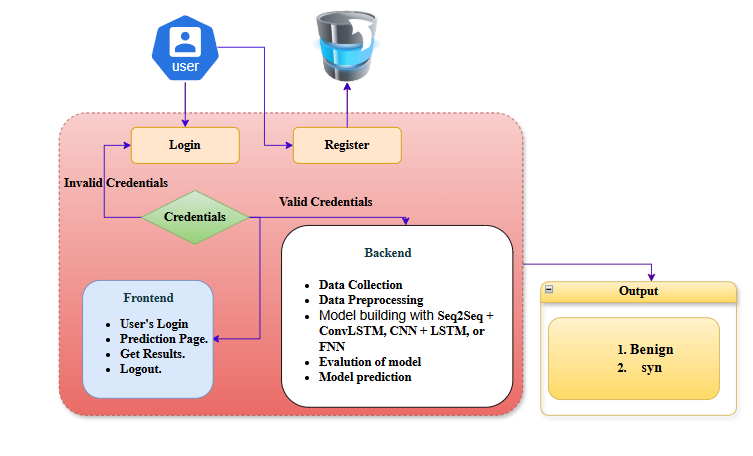
Block Diagram
Specifications
SOFTWARE REQUIREMENS
Operating System : Windows 7/8/10
Server side Script : html,css,js
Programming Language : Python
Libraries : Django, Pandas, Torch, Keras, Sklearn,Numpy , Seaborn
IDE/Workbench : VSCode
Server Deployment : Xampp Server
Database : SQLite
HARDWARE REQUIREMENTS
Processor - I3/Intel Processor
RAM - 8GB (min)
Hard Disk - 128 GB
Key Board - Standard Windows Keyboard
Mouse - Two or Three Button Mouse
Monitor - Any


 Paper Publishing

Request Call Back
Would you like to receive a free callback now?
Choose the best time for callback:
Leave your message and we will contact you as soon as possible

6-2-85/B, Old Maternity Hospital Road, Thyagaraja Nagar, Tirupati, Andhra Pradesh – 517501
+91 9030333433
+91 9393939065
0877-2261612

Disclaimer - Takeoff Edu Group Projects are not associated or affiliated with IEEE in any way. The IEEE Projects mentioned here are mentioned in the context of student projects, whose ideas are derived from IEEE publications, not projects of or by IEEE.

