A Hybrid-Arm Modular Multilevel Converters Topology with DC Low Voltage Operation and Fault Ride-Through Capability for Unidirectional HVDC Bulk Power Transmission
Objective
The main objective of the project is to maintain power transmission continuity and to compensate reactive power, to improve fault ride-through capability.
Abstract
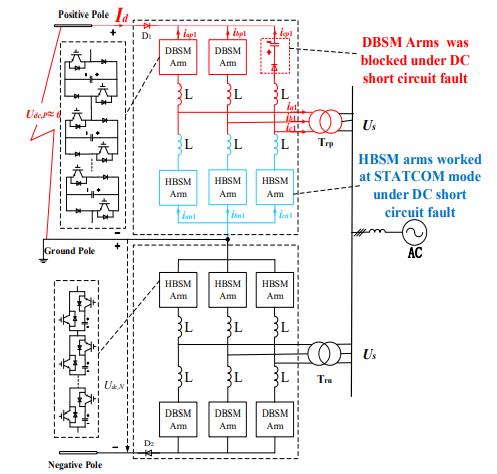
In this project, a novel Hybrid-Arm Modular Multilevel Converters (HA-MMCs) topology with DC low voltage operation and fault ride-through capability is proposed for unidirectional HVDC bulk power transmission. The HA-MMCs topology is a combination of two types of converter arms: the Half-Bridge Sub Module based arm (HBSM-arm) and the Diagonal Bridge Sub Module Based Arm (DBSM-arm). Replacing the traditional HBSM-MMC, the HA-MMCs are operated in current and reactive power control modes during normal conditions and can work as the rectifier or the inverter.
Since the DBSM can provide bipolar voltages with unipolar currents, the HA-MMCs need not change its control strategy under DC low voltage conditions caused by the high-impedance faults. Under DC pole to-pole or pole-to-ground faults, the HA-MMCs can both clear the DC fault current and work as the Static Synchronous Compensator (STATCOM) to provide reactive power to support the AC grid. Compared with other MMC topologies with DC fault ride-through capability, the HA-MMCs topology is more economical for significantly decreasing the number of power devices. The operation states, control strategy and DC low voltage operation capability of the HA-MMCs are presented and simulation results of the LCC-HA-MMC hybrid system.
Keywords: Hybrid-arm modular multilevel converters, DC low voltage operation capability, diagonal-bridge sub module (DBSM), LCC-MMC hybrid HVDC system, reactive power compensation.
NOTE: Without the concern of our team, please don't submit to the college. This Abstract varies based on student requirements.
Block Diagram
Specifications
Software Configuration:
Operating System : Windows 7/8/10
Application Software : Matlab/Simulink
Hardware Configuration:
RAM : 8 GB / 4 GB (Min)
Processor : I3 / I5(Mostly prefer)
Learning Outcomes
- Introduction to Matlab/Simulink
- What is EISPACK & LINPACK
- How to start with MATLAB
- About Matlab language
- About tools & libraries
- Application of Matlab/Simulink
- About Matlab desktop
- Features of Matlab/Simulink
- Basics on Matlab/Simulink
- Introduction to Rectifiers
- Introduction to Inverters
- Introduction to Modular multi-level converters
- Introduction to wind energy conversion systems
- Introduction to battery energy storage systems
- Introduction to HBSM
- Introduction to LPF
- Introduction to diagonal bridge sub module based arm
- Introduction to STATCOM
- Design of modular multi-level inverter
- Introduction to open loop control
- Introduction to closed loop control
- Introduction to HVDC systems
- Introduction to power electronics converters
- Introduction to phase locked loop (PLL)
- Introduction to PWM techniques
- Introduction to line commutated converters
- Introduction to parks transformation
- Introduction to Clarks transformation
- Design of transformations
- Design of HBSM
- Design of MMC
- Design of DC – DC boost converter
- We can learn about the generation of gate pulses to the SM
- We can learn about DBSM
- We can learn about buck conversion
- We can learn about buck –boost conversion
- We can learn about circulating current control
- Introduction to controllers
- Design of PI controller
- Project Development Skills:
- Problem analyzing skills
- Problem solving skills
- Creativity and imaginary skills
- Programming skills
- Deployment
- Testing skills
- Debugging skills
- Project presentation skills
- Thesis writing skills


 Paper Publishing

Request Call Back
Would you like to receive a free callback now?
Choose the best time for callback:
Leave your message and we will contact you as soon as possible

6-2-85/B, Old Maternity Hospital Road, Thyagaraja Nagar, Tirupati, Andhra Pradesh – 517501
+91 9030333433
+91 9393939065
0877-2261612

Disclaimer - Takeoff Edu Group Projects are not associated or affiliated with IEEE in any way. The IEEE Projects mentioned here are mentioned in the context of student projects, whose ideas are derived from IEEE publications, not projects of or by IEEE.

