A High-Speed FPGA-based True Random Number Generator using Metastability with Clock Managers
Objective
The main objective of this paper is to describes a novel methodology to easily design a TRNG on FPGA devices.
Abstract
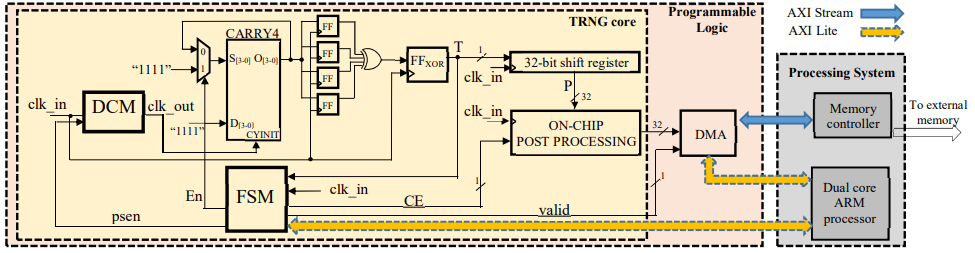
True random number generators, often known as TRNGs, are essential components of a wide variety of critical security applications. Despite the fact that digital-based solutions take use of randomness sources that are often found in the analogue domain, digital-based solutions are highly needed, particularly when they need to be implemented on Field Programmable Gate Array (FPGA)-based digital systems. In this research, an unique technique that makes the design of a TRNG on FPGA devices more straightforward is described. In order to adjust the phase shift between two clock signals, it takes use of the runtime capabilities of the hardware primitives provided by the Digital Clock Manager (DCM). The auto-tuning approach that is being given automatically adjusts the phase difference between two clock signals in order to compel one or more flip-flops (FFs) to enter the metastability zone. This region is used as a source of unpredictability in the system. In addition, an unique use of the fast carry-chain hardware primitive is offered as a means of further increasing the level of randomness present in the bits that are created. In final, a powerful on-chip post-processing strategy that does not inhibit the TRNG throughput is outlined here. This work was built in 32 and 64 data width, in verilog HDL, and synthesized in Xilinx Zynq FPGA. All of the characteristics were evaluated with regard to area, latency, and power consumption.
NOTE: Without the concern of our team, please don't submit to the college. This Abstract varies based on student requirements.
Block Diagram
Specifications
Software & Hardware Requirements
· Xilinix ISE
· HDL: Verilog
Learning Outcomes
Learning Outcomes:
- Basics of Digital Electronics
- VLSI design Flow
- Introduction to Verilog Coding
- Different modeling styles in Verilog
o Data Flow modeling
o Structural modeling
o Behavioral modeling
o Mixed level modeling
- Introduction to TRNG design
- Knowledge on FSM
- About Shift registers
- About Meta-stability
- About Interfaces
- About DCM
- Applications in real time
· Xilinx ISE 14.7/Xilinx Vivado for design and simulation
· Generation of Netlist
· Solution providing for real time problems
· Project Development Skills:
o Problem Analysis Skills
o Problem Solving Skills
o Logical Skills
o Designing Skills
o Testing Skills
o Debugging Skills
o Presentation Skills
o Thesis Writing Skills


 Paper Publishing

Request Call Back
Would you like to receive a free callback now?
Choose the best time for callback:
Leave your message and we will contact you as soon as possible

6-2-85/B, Old Maternity Hospital Road, Thyagaraja Nagar, Tirupati, Andhra Pradesh – 517501
+91 9030333433
+91 9393939065
0877-2261612

Disclaimer - Takeoff Edu Group Projects are not associated or affiliated with IEEE in any way. The IEEE Projects mentioned here are mentioned in the context of student projects, whose ideas are derived from IEEE publications, not projects of or by IEEE.

