A High Performance Shade-tolerant Mppt Based On Current-mode Control
Abstract
A High Performance Shade-Tolerant MPPT Based on Current-Mode Control
Abstract:
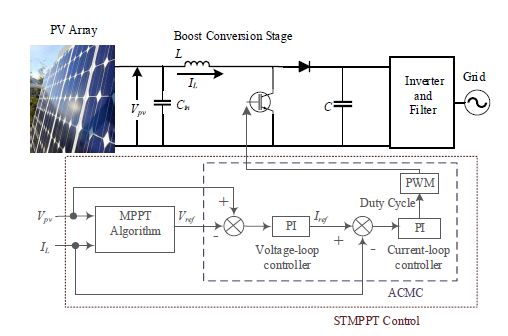
This paper proposes a high performance shade tolerant maximum power point tracking (STMPPT) technique for DC-DC converter stage of photovoltaic (PV) applications. The average current-mode control (ACMC) is utilized to regulate the PV array current using two feedback control loops. The current mode control is a superior scheme in control of DC-DC power electronic converters. The proposed STMPPT technique operates in two modes. The ACMC with the perturb and observe (P&O) MPPT algorithm functions in a local MPPT (LMPPT) mode under normal irradiance condition. When the PV array is likely to be partially shaded, a global MPPT (GMPPT) subroutine effectively scans the PV profile to optimize the PV system operation. This is achieved by implementing simple innovations to the ACMC-based P&O algorithm. The innovations benefit from useful observations of I-V characteristics. The idea behind using the I-V characteristics is to significantly reduce the search space, make the algorithm independent of shading conditions and PV array configuration, and inherently recognize the occurrence of partial shading conditions (PSCs). The proposed STMPPT technique enables very fast and reliable tracking of global maximum power point (GMPP). In addition, it can stably work under dynamic environmental change without losing correct sense of tracking direction. Its simplicity and independency would offer a viable solution for PV converter products. Simulation performance assessments are presented under different operating conditions that could happen in outdoor PV installations.
NOTE: Without the concern of our team, please don't submit to the college. This Abstract varies based on student requirements.
Block Diagram
Specifications
Software Configuration:
Operating System : Windows 7/8/10
Application Software : Matlab/Simulink
Hardware Configuration:
RAM : 8 GB / 4 GB (Min)
Processor : I3 / I5(Mostly prefer)
Learning Outcomes
- Introduction to Matlab/Simulink
- What is EISPACK & LINPACK
- How to start with MATLAB
- About Matlab language
- About tools & libraries
- Application of Matlab/Simulink
- About Matlab desktop
- Features of Matlab/Simulink
- Basics on Matlab/Simulink
- Introduction to controllers.
- Study of PWM techniques.
- Project Development Skills:
- Problem analyzing skills
- Problem solving skills
- Creativity and imaginary skills
- Programming skills
- Deployment
- Testing skills
- Debugging skills
- Project presentation skills
- Thesis writing skills


 Paper Publishing

Request Call Back
Would you like to receive a free callback now?
Choose the best time for callback:
Leave your message and we will contact you as soon as possible

6-2-85/B, Old Maternity Hospital Road, Thyagaraja Nagar, Tirupati, Andhra Pradesh – 517501
+91 9030333433
+91 9393939065
0877-2261612

Disclaimer - Takeoff Edu Group Projects are not associated or affiliated with IEEE in any way. The IEEE Projects mentioned here are mentioned in the context of student projects, whose ideas are derived from IEEE publications, not projects of or by IEEE.

