A GNN Based Artificial Intelligence Framework for Network Intrusion Detection Using CICIDS2017 Dataset
Objective
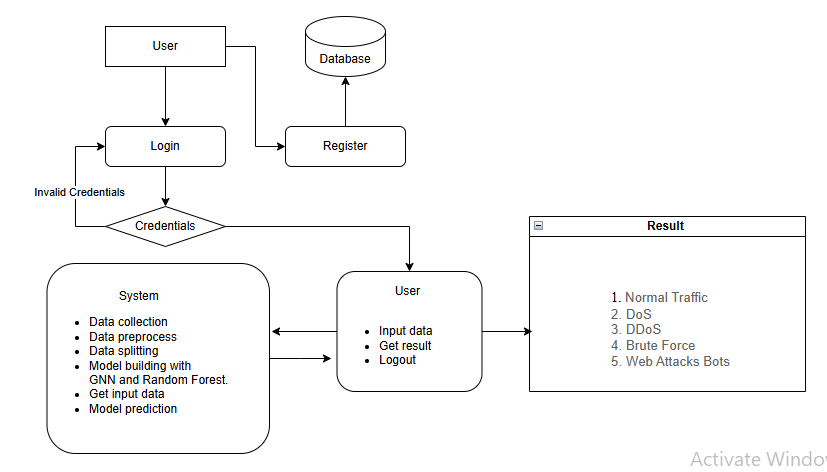
The objective of this project is to develop an advanced Network Intrusion Detection System (NIDS) by leveraging Artificial Intelligence (AI) techniques, specifically Graph Neural Networks (GNN) and Random Forest, to enhance the detection and classification of cyber-attacks. By utilizing the CICIDS2017 dataset, the project aims to tackle the challenges of multi-class attack classification and improve the overall accuracy and efficiency of detecting various types of intrusions. The goal is to provide a comprehensive AI-based solution that outperforms traditional signature-based methods, offering a robust, adaptive, and scalable approach for cybersecurity in modern, complex network environments.
Abstract
In the face of increasing cyber threats, traditional signature-based intrusion detection systems (IDS) are struggling to keep up with the evolving sophistication of cyber-attacks. The need for more adaptive and accurate detection techniques has led to the integration of Artificial Intelligence (AI), particularly Machine Learning (ML), Deep Learning (DL), and ensemble learning approaches. This paper explores the use of Graph Neural Networks (GNN) for enhancing Network Intrusion Detection Systems (NIDS), particularly focusing on the CICIDS2017 dataset. By employing AI-based models, this research highlights the potential of GNNs in accurately classifying multi-class cyber-attacks. The study provides an overview of various AI techniques, including GNN and Random Forest, and their applications in NIDS. The goal is to address the challenges faced in multi-class attack detection and offer future insights for advancing intrusion detection systems in complex and dynamic network environments.
Keywords: Artificial Intelligence, Machine Learning, Deep Learning, Graph Neural Networks, Random Forest, Intrusion Detection, Cyber-attacks, Multi-classification, Network Security, CICIDS2017 dataset.
NOTE: Without the concern of our team, please don't submit to the college. This Abstract varies based on student requirements.
Block Diagram
Specifications
Hardware Requirements
Processor - I3/Intel Processor
Hard Disk - 160GB
Key Board - Standard Windows Keyboard
Mouse - Two or Three Button Mouse
Monitor - SVGA
RAM - 8GB
Software Requirements:
Operating System : Windows 7/8/10
Server side Script : HTML, CSS, Bootstrap & JS
Programming Language : Python
Libraries : Django, Pandas, Numpy, Tensorflow, Scikit-learn.
IDE/Workbench : VS Code
Technology : Python 3.10
Database : SQLite

Demo Video


Request for Video
 Paper Publishing
Request Call Back
Would you like to receive a free callback now?
Choose the best time for callback:
Leave your message and we will contact you as soon as possible

6-2-85/B, Old Maternity Hospital Road, Thyagaraja Nagar, Tirupati, Andhra Pradesh – 517501
+91 9030333433
+91 9393939065
0877-2261612

Disclaimer - Takeoff Edu Group Projects are not associated or affiliated with IEEE in any way. The IEEE Projects mentioned here are mentioned in the context of student projects, whose ideas are derived from IEEE publications, not projects of or by IEEE.

