A Feasible Solution for Detecting Parkinson’s Disease using AI
Objective
This paper presents a state-of-the-art on automated diagnosis of Parkinson’s disease on early stage which is a neurological disorder using AI techniques so that the patients can be treated early without any delay.
Abstract
Parkinson’s disease (PD) is a long-termed, neurological disorder that causes a person to lose control over several body functions including speech. The loss of nerve cells in the part of the brain called the substantia nigra causes PD. These nerve cells or neurons create an organic chemical named dopamine which acts as a neurotransmitter between the parts of the brain and central nervous system that helps to control and co-ordinate body movements. Its detection with the help of an automated system is a subject undergoing intense study. This entails a need for incorporating a machine learning model for the early detection of PD.
This encouraged us to provide a comparative study for state of the art machine learning implementations namely Logistic Regression (LR), Support Vector Machine (SVM), Decision Tree (DT), K-nearest neighbors (KNN), Stochastic Gradient Descent (SGD) and Gaussian Naive Bayes (GNB) are executed in these modalities with their respective datasets. Furthermore, ensemble approaches such as Random Forest Classifier (RF), Adaptive Boosting (AB) and Hard Voting (HV) are implemented.
Keywords: Parkinson’s Disease, Machine Learning, Multimodal, Ensemble Approach And Bioinformatics.
NOTE: Without the concern of our team, please don't submit to the college. This Abstract varies based on student requirements.
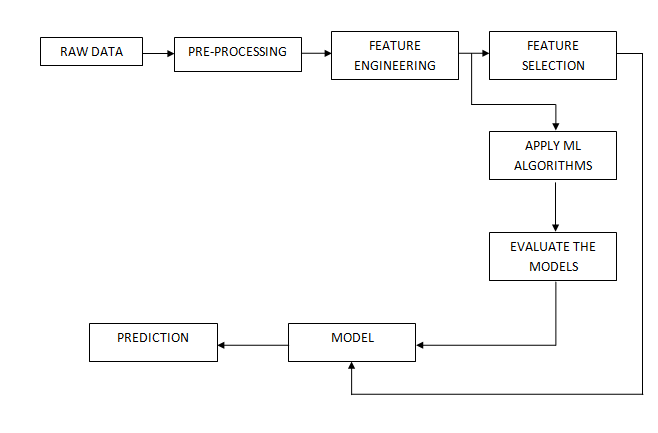
Block Diagram
Specifications
HARDWARE SPECIFICATIONS:
- Processor: I3/Intel
- Processor RAM: 4GB (min)
- Hard Disk: 128 GB
- Key Board: Standard Windows Keyboard
- Mouse: Two or Three Button Mouse
- Monitor: Any
SOFTWARE SPECIFICATIONS:
- Operating System: Windows 7+
- Server-side Script: Python 3.6+
- IDE: PyCharm, Google Colab
- Libraries Used: Pandas, Numpy, sklearn, Flask, Matplotlib.
Learning Outcomes
- Uses of Unsupervised Learning.
- Importance of classification.
- Scope of Parkinson's Disease detection.
- Use of Decision Trees and related techniques.
- Importance of PyCharm IDE.
- How ensemble models works.
- Benefits of boosting and bagging.
- Working of gradient decent.
- Implementation of KNN.
- Process of debugging a code.
- Input and Output modules
- How test the project based on user inputs and observe the output
- Project Development Skills:
- Problem analyzing skills.
- Problem solving skills.
- Creativity and imaginary skills.
- Programming skills.
- Deployment.
- Testing skills.
- Debugging skills.
- Project presentation skills.
- Thesis writing skills.


 Paper Publishing

Request Call Back
Would you like to receive a free callback now?
Choose the best time for callback:
Leave your message and we will contact you as soon as possible

6-2-85/B, Old Maternity Hospital Road, Thyagaraja Nagar, Tirupati, Andhra Pradesh – 517501
+91 9030333433
+91 9393939065
0877-2261612

Disclaimer - Takeoff Edu Group Projects are not associated or affiliated with IEEE in any way. The IEEE Projects mentioned here are mentioned in the context of student projects, whose ideas are derived from IEEE publications, not projects of or by IEEE.

