A EV Battery Charger Using a PFC based Bridgeless SEPIC Converter
Also Available Domains DC - DC Converters
Objective
The main objective of this paper is to design and implement an advanced control strategy for improving the performance, stability, and dynamic response of the proposed power electronic system under varying operating conditions. The study focuses on enhancing voltage regulation, reducing harmonic distortion, and improving overall system efficiency.
Abstract
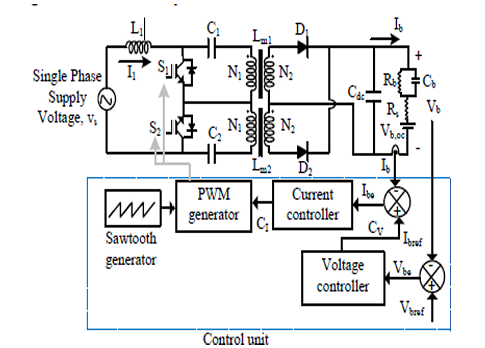
Conventional PFC circuits in EV (Electric Vehicle) battery chargers have the efficiency limitation. To overcome this issue, there were losses associated with thw DBR, hence a bridgeless single ended primary inductance converter (SEPIC) with improved power quality is presented in this paper. Input current drawn by the charger shows a unity power factor operation in a complete switching cycle. Due to elimination of DBR, conduction losses are significantly controlled. The overall performance of the proposed bridgeless SEPIC converter is analysed with the help of various operating modes. The battery is charged at constant current/ constant voltage control mode and it provides satisfactory results for inherent power factor correction, thus, improving overall performance of the charger.
Keywords: Electric Vehicle; Bridgeless system SEPIC Converter; Diode bridge rectifier (DBR); Power Quality; Constant Current/Constant Voltage (CC/CV) control
NOTE: Without the concern of our team, please don't submit to the college. This Abstract varies based on student requirements.
Block Diagram
Specifications
Software Configuration:
Operating System : Windows 7/8/10
Application Software: Matlab / Simulink
Hardware Configuration:
RAM : 8 GB
Processor : I3 / I5 (Mostly prefer)
Learning Outcomes
· Introduction to Matlab/Simulink
· How to start with MATLAB
· About Matlab language
· About tools & libraries
· Application of Matlab/Simulink
· Basics on Matlab/Simulink
· Introduction to converters
· Introduction to switches
· Introduction to PFC.
· We can learn about Synchronous Reluctance Motors
· We can learn about Linear-Quadratic Integral Regulator
· We can learn about PWM Technique
· Project Development Skills:
o Problem analyzing skills
o Problem solving skills
o Creativity and imaginary skills
o Programming skills
o Deployment
o Testing skills
o Debugging skills
Demo Video


Request for Video
 Paper Publishing
Request Call Back
Would you like to receive a free callback now?
Choose the best time for callback:
Leave your message and we will contact you as soon as possible

6-2-85/B, Old Maternity Hospital Road, Thyagaraja Nagar, Tirupati, Andhra Pradesh – 517501
+91 9030333433
+91 9393939065
0877-2261612

Disclaimer - Takeoff Edu Group Projects are not associated or affiliated with IEEE in any way. The IEEE Projects mentioned here are mentioned in the context of student projects, whose ideas are derived from IEEE publications, not projects of or by IEEE.

