A Dynamic Selection Hybrid Model for Advancing Thyroid Care with BOOST Balancing Method.
Objective
The objective of this study is to develop a Dynamic Selection Hybrid Model aimed at enhancing the diagnostic process for thyroid disorders, specifically hypothyroidism and hyperthyroidism and the particular condition, by implementing the BOOST Balancing Method. This technique will address the issue of imbalanced data commonly found in thyroid disorder datasets.
Abstract
Thyroid disorders, including hypothyroidism and hyperthyroidism, pose significant challenges in diagnosis due to their complex nature and the imbalanced distribution of related medical data. Traditional machine learning models have shown promise in classifying thyroid conditions, yet they struggle to maintain high accuracy and adaptability in the presence of evolving, imbalanced datasets. This study aims to develop a Dynamic Selection Hybrid Model to improve the diagnostic process for thyroid disorders. By integrating a variety of machine learning algorithms such as Decision Trees, Support Vector Machines (SVM), K-Nearest Neighbors (KNN), Random Forest, AdaBoost, and Gradient Boosting—into an Adaptive Dynamic Ensemble Framework, the model dynamically selects the most effective classifier based on the input data. To further enhance performance, the BOOST Balancing Method is implemented to address the challenges of data imbalance, ensuring accurate classification across eight specific thyroid conditions: hyperthyroid, T3 toxic, toxic goiter, secondary toxic, hypothyroid, primary hypothyroid, compensated hypothyroid, and secondary hypothyroid. Experimental validation using thyroid disorder datasets demonstrates that the proposed system significantly outperforms static models, higher classification accuracy, and improved handling of imbalanced data. This dynamic model aims to provide a more accurate, flexible, and responsive solution for thyroid disease diagnosis, ultimately advancing the precision and quality of thyroid care.
Keywords: Thyroid Care, Dynamic Selection Hybrid Model, Ensemble Methods.
NOTE: Without the concern of our team, please don't submit to the college. This Abstract varies based on student requirements.
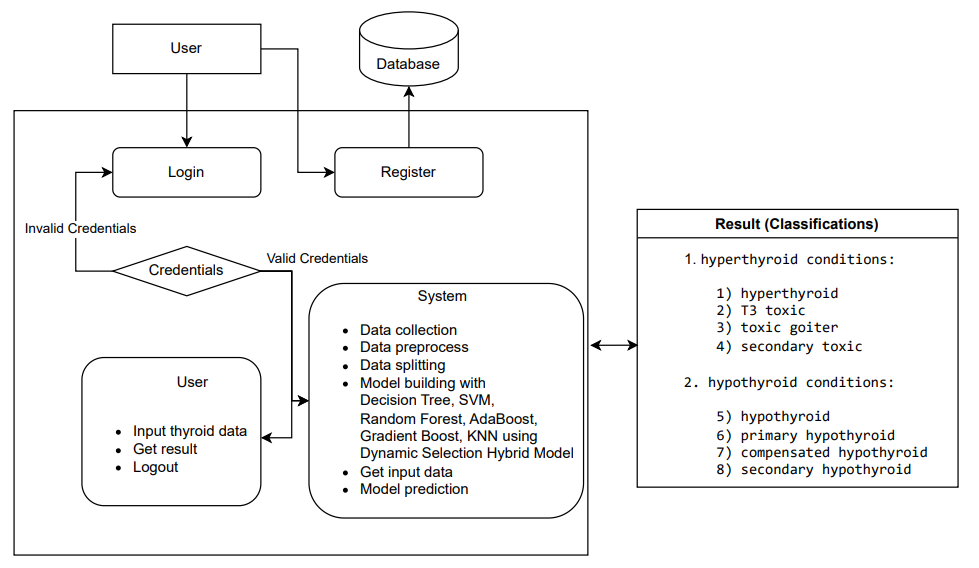
Block Diagram
Specifications
H/W CONFIGURATION:
Processor - I3/Intel Processor
Hard Disk - 160GB
Key Board - Standard Windows Keyboard
Mouse - Two or Three Button Mouse
Monitor - SVGA
RAM - 8GB
S/W CONFIGURATION:
• Operating System : Windows 7/8/10
• Server side Script : HTML, CSS, Bootstrap & JS
• Programming Language : Python
• Libraries : Flask, Pandas, Mysql.connector, Os, Scikit-learn, Numpy
• IDE/Workbench : PyCharm
• Technology : Python 3.6+
• Server Deployment : Xampp Server

Demo Video


Request for Video
 Paper Publishing
Request Call Back
Would you like to receive a free callback now?
Choose the best time for callback:
Leave your message and we will contact you as soon as possible

6-2-85/B, Old Maternity Hospital Road, Thyagaraja Nagar, Tirupati, Andhra Pradesh – 517501
+91 9030333433
+91 9393939065
0877-2261612

Disclaimer - Takeoff Edu Group Projects are not associated or affiliated with IEEE in any way. The IEEE Projects mentioned here are mentioned in the context of student projects, whose ideas are derived from IEEE publications, not projects of or by IEEE.

