A Dual-Stream Deep Learning Architecture With Adaptive Random Vector Functional Link for Multi-Center Ischemic Stroke Classification
Objective
A Dual-Stream Deep Learning Architecture with Adaptive Random Vector Functional Link for Multi-Center Ischemic Stroke Classification” presents an advanced framework for accurate stroke classification across diverse medical centers. It leverages a dual-stream deep learning model that processes both imaging and clinical data simultaneously, enhancing diagnostic precision. The adaptive Random Vector Functional Link (RVFL) layer dynamically optimizes feature representations, improving generalization across heterogeneous datasets. This approach addresses challenges of data variability in multi-center environments, enabling robust, scalable, and efficient stroke detection. The proposed system significantly enhances early diagnosis, supporting clinical decision-making and improving patient outcomes in ischemic stroke care.
Abstract
The project titled “A Dual-Stream Deep Learning Architecture with Adaptive Random Vector Functional Link for Multi-Center Ischemic Stroke Classification” presents an intelligent and automated framework to improve the diagnosis and classification of ischemic stroke across diverse medical centers. Stroke, particularly ischemic stroke, remains one of the leading causes of mortality and long-term disability worldwide. Traditional classification approaches are often limited by dataset variability, noise, and the complex nature of brain imaging data. To address these challenges, this work integrates a dual-stream deep learning architecture with an Adaptive Random Vector Functional Link (ARVFL) network to enhance learning efficiency and robustness. The dual-stream network leverages convolutional layers to capture both local spatial details and global contextual features from medical images, while ARVFL acts as an adaptive classifier that improves generalization across heterogeneous datasets. The system is implemented using a Flask-based web application, enabling real-time stroke image uploads, classification into categories such as Bleeding, Ischemia, and Normal, and providing user-friendly accessibility. Additionally, the model’s multi-center adaptability ensures reliability when trained and tested on datasets from varied medical institutions, overcoming limitations of single-source training. With its scalable design and robust classification accuracy, the proposed system demonstrates potential to support neurologists in early detection, reduce misdiagnosis, and enhance patient care outcomes in clinical practice.
Keywords
Ischemic Stroke, Dual-Stream Deep Learning, Adaptive Random Vector Functional Link (ARVFL), Multi-Center Classification, Medical Image Analysis, Flask Application, Stroke Diagnosis.
NOTE: Without the concern of our team, please don't submit to the college. This Abstract varies based on student requirements.
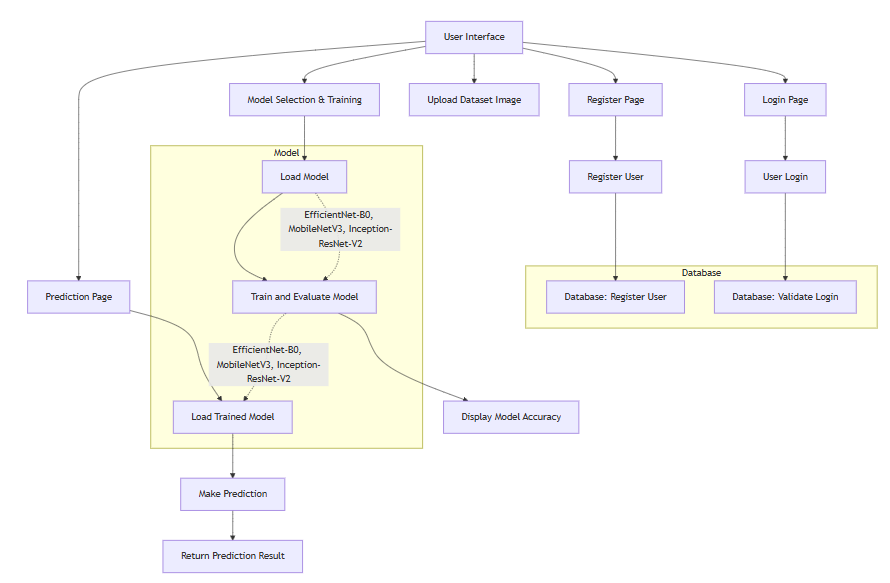
Block Diagram
Specifications
4.2 SOFTWARE REQUIREMENS
Operating System : Windows 7/8/10
Server-side Script : HTML, CSS, Bootstrap & JS
Programming Language : Python
Libraries : Flask, Pandas,Pytorch, Sklearn, NumPy, Seaborn, Matplotlib,Tensorflow
IDE/Workbench : VSCode
Technology : Python 3.8+
Server Deployment : Xampp Server
Database : MySQL
4.3 HARDWARE REQUIREMENTS
Processor - I5/Intel Processor
RAM - 8GB +(min)
Hard Disk - 128 +GB
Key Board - Standard Windows Keyboard
Mouse - Two or Three Button Mouse
Monitor - Any


 Paper Publishing

Request Call Back
Would you like to receive a free callback now?
Choose the best time for callback:
Leave your message and we will contact you as soon as possible

6-2-85/B, Old Maternity Hospital Road, Thyagaraja Nagar, Tirupati, Andhra Pradesh – 517501
+91 9030333433
+91 9393939065
0877-2261612

Disclaimer - Takeoff Edu Group Projects are not associated or affiliated with IEEE in any way. The IEEE Projects mentioned here are mentioned in the context of student projects, whose ideas are derived from IEEE publications, not projects of or by IEEE.

