A Dual-Branch Deep Learning Framework Combining Xception and ResNet for Accurate Lung and Colon Cancer Detection
Objective
The objective of this project is to develop an advanced deep learning framework for the accurate detection of lung and colon cancers from histopathological images. By leveraging dual-branch architectures combining ResNet and EfficientNet, as well as multi-branch models incorporating ResNet, Xception, and DenseNet, the project aims to enhance the classification performance of cancer detection systems. Key goals include addressing challenges such as overfitting, poor generalization, and class imbalance, while improving diagnostic accuracy, precision, and recall. The project strives to automate cancer diagnosis, offering a reliable tool for early detection that can support clinicians in making informed decisions, ultimately improving survival rates.
Abstract
Lung and colon cancers are among the most prevalent and deadly cancer types worldwide, with early detection being crucial for improving survival rates. Traditional diagnostic methods, such as manual histopathological image analysis, are time-consuming, prone to errors, and often inconsistent. To address these challenges, this study proposes a dual-branch deep learning framework combining ResNet and EfficientNet architectures for the accurate detection of lung and colon cancers from histopathological images. By leveraging the strengths of both ResNet’s residual learning and EfficientNet’s efficient scaling, the framework aims to improve the classification performance while mitigating issues like overfitting, poor generalization, and class imbalance. The study also explores the potential of a multi-branch approach by integrating ResNet, Xception, and DenseNet, further enhancing model robustness and accuracy. Comprehensive experiments are conducted on a large dataset of cancerous histopathological images, demonstrating the superior performance of the proposed models in terms of accuracy, precision, recall, and F1-score. The results show that the dual and multi-branch models significantly outperform existing approaches, highlighting their potential for real-world clinical applications in cancer diagnosis.
Keywords: Lung Cancer, Colon Cancer, Deep Learning, ResNet, EfficientNet, Xception, DenseNet, Multi-Branch Models, Dual-Branch Models, Histopathological Image Analysis, Overfitting, Class Imbalance, Model Generalization, Cancer Detection.
NOTE: Without the concern of our team, please don't submit to the college. This Abstract varies based on student requirements.
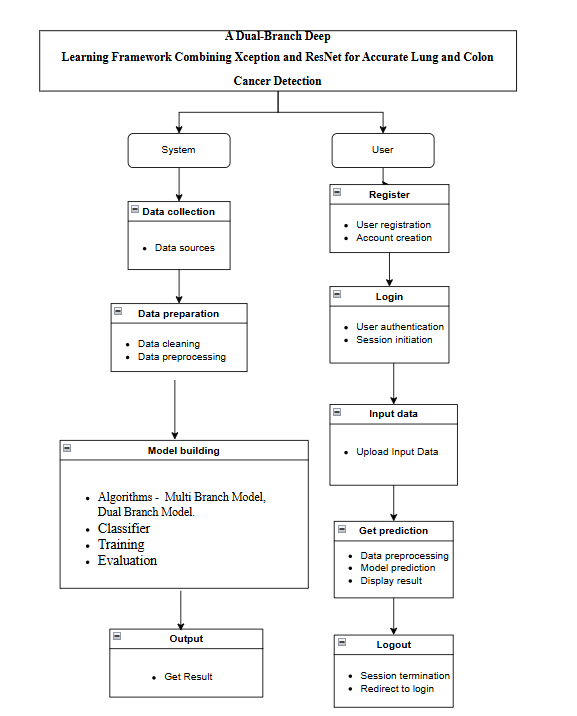
Block Diagram
Specifications
Hardware Requirements
Processor - I3/Intel Processor
Hard Disk - 160GB
Key Board - Standard Windows Keyboard
Mouse - Two or Three Button Mouse
Monitor - SVGA
RAM - 8GB
Software Requirements:
Operating System : Windows 7/8/10
Server side Script : HTML, CSS, Bootstrap & JS
Programming Language : Python
Libraries : Django, Pandas, Numpy, Tensorflow, Scikit-learn.
IDE/Workbench : VS Code
Technology : Python 3.10
Database : SQLite

Demo Video


Request for Video
 Paper Publishing
Request Call Back
Would you like to receive a free callback now?
Choose the best time for callback:
Leave your message and we will contact you as soon as possible

6-2-85/B, Old Maternity Hospital Road, Thyagaraja Nagar, Tirupati, Andhra Pradesh – 517501
+91 9030333433
+91 9393939065
0877-2261612

Disclaimer - Takeoff Edu Group Projects are not associated or affiliated with IEEE in any way. The IEEE Projects mentioned here are mentioned in the context of student projects, whose ideas are derived from IEEE publications, not projects of or by IEEE.

