A Deep Learning Framework for Emergency Drone Landing Zone Detection
Objective
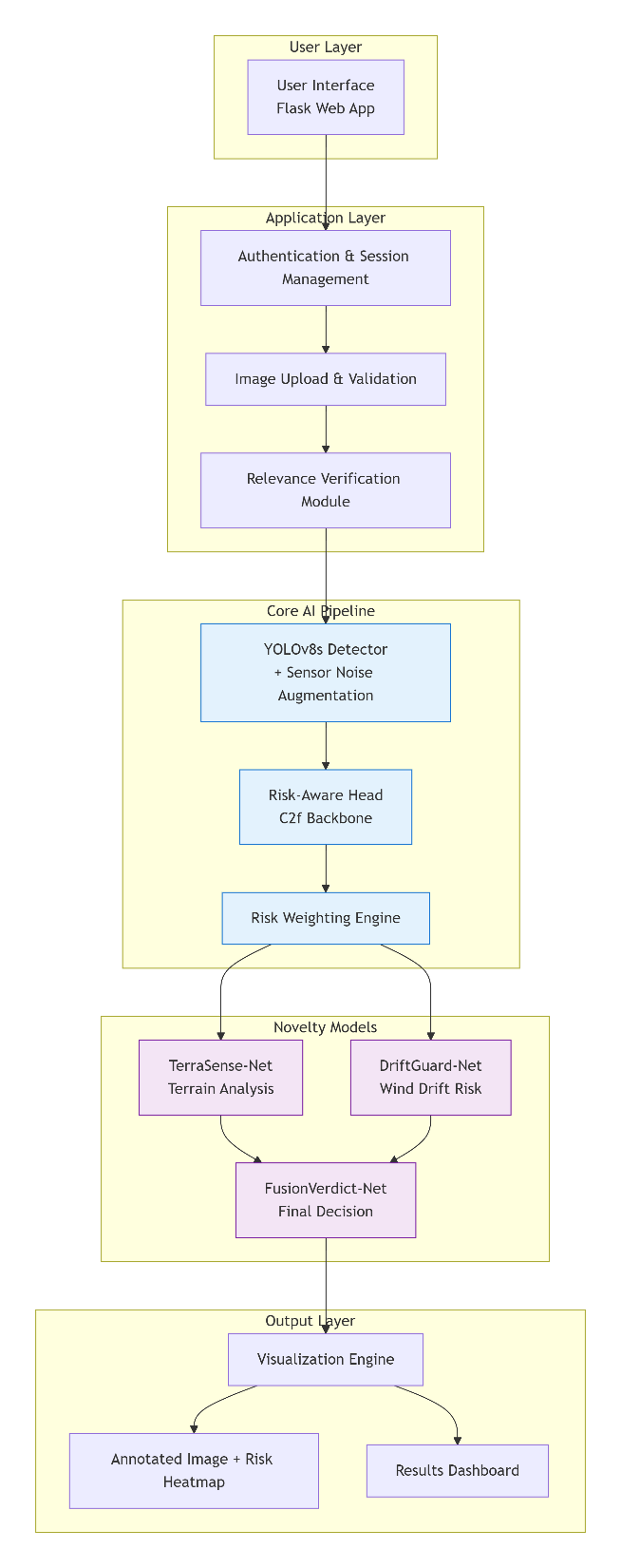
The primary objective of this project is to develop an intelligent, real-time system for Emergency Drone Landing Zone Detection using deep learning. The proposed framework utilizes a fine-tuned YOLOv8 model to accurately detect critical objects such as Vehicles, Persons, Unmanned Aerial Platforms (UAP), and Unmanned Aerial Instruments (UAI) in aerial imagery. The system computes a weighted Landing Safety Score and classifies potential landing zones as SAFE, RISKY, or UNSAFE. A comprehensive relevance verification mechanism ensures only contextually valid emergency scenes are processed. The framework is implemented as a secure, user-friendly web application using the Flask framework, enabling authenticated users to upload images and receive instant analysis with visual explanations including annotated images and risk heatmaps.
Abstract
This
research presents a novel, research-grade pipeline for drone landing safety
assessment that integrates a custom YOLOv8s object detector with advanced
risk-aware modules. The system addresses real-world challenges such as sensor
noise, terrain variability, and environmental drift through several
innovations: class-specific risk weights for detected objects (Vehicle, UAP,
UAI, Person), Sensor Noise Augmentation embedded during YOLO training, and a
Risk-Aware Head directly hooked to YOLO backbone (C2f) features. Three
specialized neural networks—TerraSense-Net (terrain roughness estimation),
DriftGuard-Net (wind-drift risk prediction), and FusionVerdict-Net (final
SAFE/RISKY/UNSAFE classification)—are trained on synthetic labels derived from
detection outputs and image statistics, achieving high evaluation metrics
(FusionVerdict-Net: ~99.86% accuracy, strong F1 scores).A production-ready
Flask web application operationalizes the pipeline, enabling authenticated
users to upload aerial images. The system performs relevance filtering, YOLO
detection, risk mapping, novelty model inference, and generates annotated
visualizations with comprehensive safety verdicts. This end-to-end solution
bridges cutting-edge computer vision research with practical deployment for
safer autonomous drone operations.
Keywords: Drone Landing Safety, YOLOv8, Risk-Aware Detection, Sensor Noise Augmentation, TerraSense-Net, DriftGuard-Net, FusionVerdict-Net, Risk-Weighted Classification, Computer Vision, Autonomous Systems.
NOTE: Without the concern of our team, please don't submit to the college. This Abstract varies based on student requirements.
Block Diagram
Specifications
4.1 SOFTWARE REQUIREMENS
Operating System
Windows 10 / 11 (64-bit) or Linux (Ubuntu 20.04+)
Programming Language
Python 3.10 or above
Web Framework
Flask
Deep Learning Framework
Ultralytics YOLOv8
Computer Vision Library
OpenCV
Data Processing Libraries
NumPy, Pandas
Other Libraries
Werkzeug, Flask-WTF, CSRFProtect, mysql-connector-python, Pillow
Frontend Technologies
HTML5, CSS3, Bootstrap 5, JavaScript
Database
MySQL
IDE / Editor
Visual Studio Code / PyCharm
Model File Format
.pt (YOLOv8 PyTorch format)
Server Deployment
Localhost / Flask Development Server
4.2 HARDWARE REQUIREMENTS
Processor
Intel Core i5 / AMD Ryzen 5
Intel Core i7 / AMD Ryzen 7 or higher
RAM
8 GB
16 GB or higher
Hard Disk
256 GB SSD
512 GB SSD or higher
Graphics Card
Integrated Graphics
NVIDIA GPU with CUDA support (for faster inference)
Keyboard
Standard Windows Keyboard
Standard Windows Keyboard
Mouse
Two or Three Button Mouse
Two or Three Button Mouse
Monitor
15-inch or above
17-inch or above


 Paper Publishing

Request Call Back
Would you like to receive a free callback now?
Choose the best time for callback:
Leave your message and we will contact you as soon as possible

6-2-85/B, Old Maternity Hospital Road, Thyagaraja Nagar, Tirupati, Andhra Pradesh – 517501
+91 9030333433
+91 9393939065
0877-2261612

Disclaimer - Takeoff Edu Group Projects are not associated or affiliated with IEEE in any way. The IEEE Projects mentioned here are mentioned in the context of student projects, whose ideas are derived from IEEE publications, not projects of or by IEEE.

