A Deep Learning-Based Intelligent, Intrusion Detection System for the Internet of, Medical Things
Objective
The primary objective of this project is to develop an intelligent Intrusion Detection System (IDS) for the Internet of Medical Things (IoMT) networks using deep learning techniques. The system will be capable of detecting and mitigating cyber threats in real-time by leveraging four machine learning algorithms: Random Forest, LightGBM, and two hybrid models that combine Convolutional Neural Networks (CNN) with Random Forest and LightGBM for enhanced feature extraction and anomaly detection. The key goals of the project include:Real-Time Threat Detection: Implementing a solution that can detect cyber threats as they occur, ensuring immediate response and minimizing the impact of security breaches.
Abstract
The Internet of Medical Things (IoMT) has significantly improved healthcare services by enabling the seamless connectivity of medical devices for data transmission and monitoring. However, the increase in connected medical devices also brings vulnerabilities, making security a critical concern. This project presents an Intelligent Intrusion Detection System (IDS) for IoMT based on deep learning techniques, aiming to detect and mitigate cyber threats in real-time. The system leverages four machine learning algorithms: Random Forest, LightGBM, XGBoost and two hybrid models combining Convolutional Neural Networks (CNN) as feature extractors with Random Forest and LightGBM, XGBoost classifiers. These models are applied to detect anomalies and identify potential threats within IoMT networks by analyzing various device-generated data patterns. The project utilizes CNN-based feature extraction to capture complex patterns in the data, enhancing the performance of traditional machine learning models. The models are trained and evaluated using Python, with libraries such as scikit-learn for Random Forest and LightGBM, XGBoost and Keras for CNN implementation. The IDS aims to provide a robust, scalable solution to ensure the security of IoMT systems, enabling real-time threat detection, minimizing risks, and protecting patient data. By combining both classical and deep learning techniques, the project explores the potential of advanced security measures for IoMT and emphasizes the growing importance of intelligent intrusion detection in modern healthcare environments.
Keywords: Internet of Medical Things (IoMT), Intrusion Detection System, Random Forest, LightGBM, XGBoost CNN, Feature Extraction, Deep Learning, Machine Learning, Cybersecurity, Healthcare Security, Anomaly Detection, Real-Time Threat Detection, Python.
NOTE: Without the concern of our team, please don't submit to the college. This Abstract varies based on student requirements.
Block Diagram
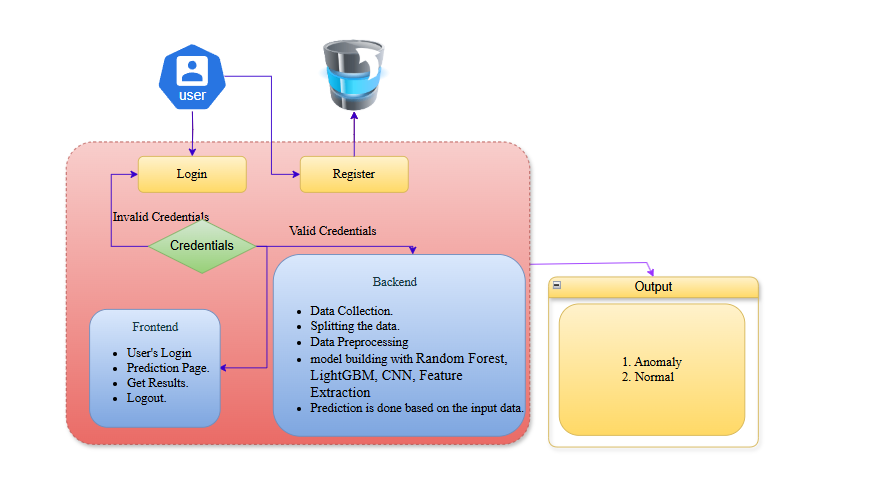
Specifications
SOFTWARE REQUIREMENS
Operating System : Windows 7/8/10
Server side Script : html,css,js
Programming Language : Python
Libraries : Django, Pandas, Torch, Keras, Sklearn,Numpy , Seaborn
IDE/Workbench : VSCode
Server Deployment : Xampp Server
Database : SQLite
HARDWARE REQUIREMENTS
Processor - I3/Intel Processor
RAM - 8GB (min)
Hard Disk - 128 GB
Key Board - Standard Windows Keyboard
Mouse - Two or Three Button Mouse
Monitor - Any


 Paper Publishing

Request Call Back
Would you like to receive a free callback now?
Choose the best time for callback:
Leave your message and we will contact you as soon as possible

6-2-85/B, Old Maternity Hospital Road, Thyagaraja Nagar, Tirupati, Andhra Pradesh – 517501
+91 9030333433
+91 9393939065
0877-2261612

Disclaimer - Takeoff Edu Group Projects are not associated or affiliated with IEEE in any way. The IEEE Projects mentioned here are mentioned in the context of student projects, whose ideas are derived from IEEE publications, not projects of or by IEEE.

