A DC to 20 GHz Variable Gain Amplifier with Tunable Input Matching in 22 nm FDSOI Technology
Objective
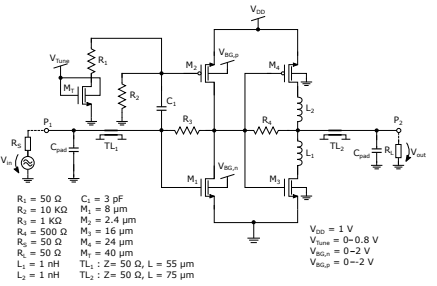
The design and characterization of a broadband radio-frequency variable-gain baseband amplifier, enhanced with tunable input-impedance matching and implemented in a 22 nm fully-depleted silicon-on-insulator technology is presented
Abstract
Error correction codes (ECCs) are commonly used to look after memories next to errors. The proposed technique we are detect the one or more errors and to correct on its own bit error. Among ECCs, Orthogonal Latin Squares (OLS) codes have gain renewed interest for memory defense due to their modularity and the simplicity of the decoding algorithm that enable low down delay implementations. The general idea for achieving error detection and correction is to add some redundancy which means to add some extra data to a message, which receiver can use to check uniformity of the delivered message, and to pick up data determined to be corrupt. A significant issue is that when ECCs is used, the encoder and decoder circuits can also suffer errors. In this brief, a concurrent error detection technique designed for OLS codes encoders be proposed and evaluated. The proposed method uses the properties of OLS codes in the direction of efficiently implement a parity prediction scheme that protects the encoder.
NOTE: Without the concern of our team, please don't submit to the college. This Abstract varies based on student requirements.
Block Diagram
Specifications
Software Requirements:
· Cadence virtuoso
· Technology files: 45nm
Hardware Requirements:
· Microsoft® Windows XP
· Intel® Pentium® 4 processor or Pentium 4 equivalent with SSE support
· 512 MB RAM
· 100 MB of available disk space
Learning Outcomes
Learning Outcomes:
- Introduction to Digital Electronics
- Analysis of digital circuits
- Importance of Multipliers
- Disadvantages of existing multipliers
- Knowledge on bypass technique
- Xilinx ISE/VIVADO software tool for code and simulation
- Solution providing for real time problems
- Project Development Skills:
- Problem Analysis Skills
- Problem Solving Skills
- Logical Skills
- Designing Skills
- Testing Skills
- Debugging Skills
- Presentation skills
- Thesis Writing Skills


 Paper Publishing

Request Call Back
Would you like to receive a free callback now?
Choose the best time for callback:
Leave your message and we will contact you as soon as possible

6-2-85/B, Old Maternity Hospital Road, Thyagaraja Nagar, Tirupati, Andhra Pradesh – 517501
+91 9030333433
+91 9393939065
0877-2261612

Disclaimer - Takeoff Edu Group Projects are not associated or affiliated with IEEE in any way. The IEEE Projects mentioned here are mentioned in the context of student projects, whose ideas are derived from IEEE publications, not projects of or by IEEE.

