A Data-flow Methodology for Accelerating FFT
Also Available Domains DSP Core
Project Code :TVMAFE47
Objective
In this paper, we discuss about an efficient way to obtain Fast Fourier Transform algorithm (FFT).
Abstract
The N-point digital Fourier transform involves hard the real number of the sample buffer with N
separate basis vectors. Since every real number involves N multiplications and N additions, the
whole time is proportional to N2, in different words, it’s an O(N2) algorithmic rule. However, it
turns out that by smartly re arranging these operations, one will optimize the algorithmic rule all
the way down to O(Nlog2(N)), that for large N makes a large difference. The optimized version
of the algorithmic rule is named the fast Fourier transform, or the FFT. During this paper, we
tend to discuss regarding an efficient way to obtain Fast Fourier transform algorithm (FFT).
According to our study, we are able to eliminate some operations in hard the FFT algorithmic
rule due to property of complex numbers and that we are able to do the FFT during a higher
execution time because of a major reduction of the required twiddle factors and to extra
factorizations
NOTE: Without the concern of our team, please don't submit to the college. This Abstract varies based on student requirements.
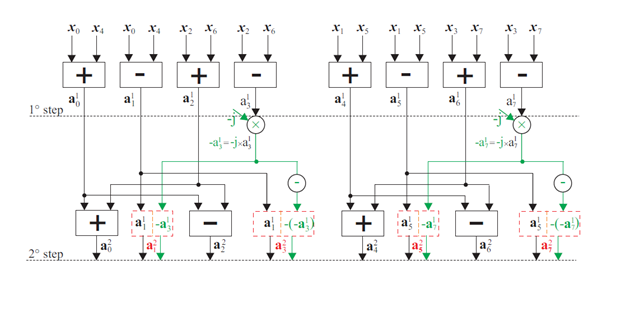
Block Diagram
Specifications
Front End : Xilinx ISE 14.7 or cadence for Synthesis, Simulation and
Implementation

Contact Us
- info@takeoffprojects.com
- +91 9030333433, +91 9393939065


 Paper Publishing

Request Call Back
Would you like to receive a free callback now?
Choose the best time for callback:
Leave your message and we will contact you as soon as possible

6-2-85/B, Old Maternity Hospital Road, Thyagaraja Nagar, Tirupati, Andhra Pradesh – 517501
+91 9030333433
+91 9393939065
0877-2261612

Disclaimer - Takeoff Edu Group Projects are not associated or affiliated with IEEE in any way. The IEEE Projects mentioned here are mentioned in the context of student projects, whose ideas are derived from IEEE publications, not projects of or by IEEE.

