A Comparative Analysis of Machine Learning Models for Colon Cancer Classification
Objective
The objective of this study is to assess the performance of five distinct machine learning techniques, namely Random Forest (RF), Decision Tree (DT), Support Vector Machine (SVM), Naïve Bayes (NB), and K-Nearest Neighbor (KNN), in the automatic classification of colon cancer among different age groups. The study aims to evaluate the accuracy of these models and their potential for assisting in the early detection and classification of colon cancer based on gene expression data.
Abstract
In recent years, the automatic classification of cancer cells, particularly in the context of colon cancer, has emerged as a formidable challenge in the field of machine learning (ML). Colon cancer is a disease that can affect individuals of all ages but is more prevalent among older populations. Advances in computational methods, particularly ML, have revolutionized the way we approach the classification of various types of diseases, including colon cancer. These ML algorithms have greatly reduced the need for extensive human intervention and have made it possible to analyze vast amounts of medical data efficiently. This study explores the classification of colon cancer across different age groups by employing five distinct ML techniques: Random Forest (RF), Decision Tree (DT), Support Vector Machine (SVM), Naïve Bayes (NB), and K-Nearest Neighbor (KNN). The research leverages the significant strides made in gene technology and gene expression data analysis, despite the inherent challenges of dealing with high-dimensional and limited quantity medical data. Remarkably, the results of this investigation demonstrate that the majority of the implemented ML models achieve an average accuracy rate exceeding expectations. These findings underscore the potential of ML as a powerful tool in the ongoing effort to enhance the classification and diagnosis of colon cancer, especially when considering age-specific variations. This research paves the way for more accurate and efficient early detection and treatment strategies, ultimately improving patient outcomes and healthcare practices.
Keywords: Machine Learning (ML), Support vector Machine (SVM), Colon Cancer, Random Forest (RF), Decision Tree (DT), K-Nearest Neighbor (KNN).
NOTE: Without the concern of our team, please don't submit to the college. This Abstract varies based on student requirements.
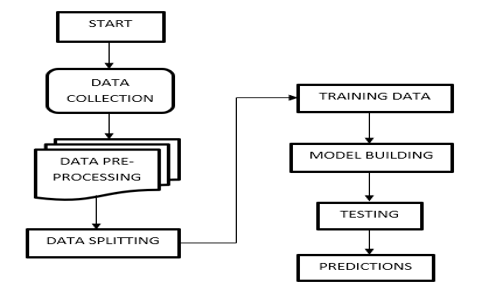
Block Diagram
Specifications
H/W CONFIGURATION:
• Processor - I7/Intel Processor
• Hard Disk - 160GB
• Key Board - Standard Windows Keyboard
• Mouse - Two or Three Button Mouse
• RAM - 8Gb
S/W CONFIGURATION:
• Operating System : Windows 11
• Server side Script : Python, HTML, MYSQL, CSS, Bootstrap.
• Libraries : PANDAS, Django
• IDE : PyCharm (or) VS code
• Technology : Python 3.10


 Paper Publishing

Request Call Back
Would you like to receive a free callback now?
Choose the best time for callback:
Leave your message and we will contact you as soon as possible

6-2-85/B, Old Maternity Hospital Road, Thyagaraja Nagar, Tirupati, Andhra Pradesh – 517501
+91 9030333433
+91 9393939065
0877-2261612

Disclaimer - Takeoff Edu Group Projects are not associated or affiliated with IEEE in any way. The IEEE Projects mentioned here are mentioned in the context of student projects, whose ideas are derived from IEEE publications, not projects of or by IEEE.

