A Comparative Analysis of Machine Learning Algorithms for Clinical Decision Support in Early Heart Failure Mortality Prediction
Objective
To analyze and compare the performance of various machine learning algorithms for early prediction of heart failure mortality in clinical decision support systems. To improve prediction accuracy and assist healthcare professionals in early diagnosis and risk assessment, enabling better patient management and informed clinical decision-making.
Abstract
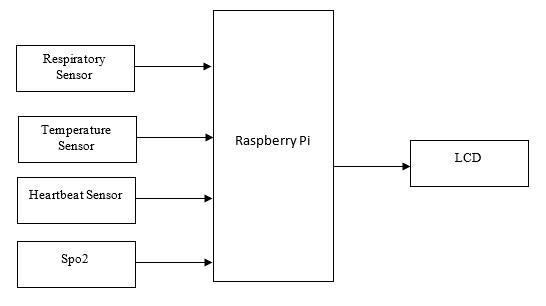
This project presents a comparative analysis of machine learning algorithms, including Random Forest, for clinical decision support in early heart failure mortality prediction. The system utilizes sensors such as a heart beat sensor, SpO2 sensor, temperature sensor, and respiratory sensor to continuously monitor vital health parameters in real time. The collected data is processed and analyzed using machine learning algorithms to evaluate the patient’s condition and predict the risk of heart failure. Among the algorithms, Random Forest is used for its high accuracy and reliable performance in classification. Based on this prediction, the system provides appropriate medical suggestions or medicine recommendations to assist healthcare decisions. An LCD display is used to show real-time readings and system outputs. By comparing different machine learning models, the system identifies the most accurate approach for prediction. This method enables early diagnosis, improves treatment decisions, and enhances overall patient monitoring in modern healthcare systems
NOTE: Without the concern of our team, please don't submit to the college. This Abstract varies based on student requirements.
Block Diagram
Specifications
Hardware components:
- Heart Beat Sensor
- SpO2 Sensor
- Temperature Sensor
- Raspberry pi
- Respiratory Sensor
- SD card
- LCD Display
- Power Supply
- Adapter
Software components:
- Python
- Rasbian OS
Learning Outcomes
- Understand Raspberry Pi architecture and GPIO configuration
- Learn how to install and configure Raspbian OS and required Python libraries
- Interface analog sensors with Raspberry Pi using MCP3008 ADC
- Implement image classification using Artificial Neural Networks
- Develop real-time skin analysis using USB camera input
- Build automated health screening systems with display and alert features
- Integrate temperature and heartbeat monitoring in diagnostic systems
- Analyze and interpret classification output for healthcare applications
- About Project Development Life Cycle:
- Planning and Requirement Gathering (software’s, Tools, Hardware components, etc.,)
- Schematic preparation
- Code development and debugging
- Hardware development and debugging
- Development of the Project and Output testing
- Practical exposure to:
- Hardware and software tools.
- Solution providing for real time problems.
- Working with team/ individual.
- Work on Creative ideas.
- Project development Skills:
- Problem analyzing skills
- Problem solving skills
- Creativity and imaginary skills
- Programming skills
- Deployment
- Testing skills
- Debugging skills
- Project presentation skills


 Paper Publishing

Request Call Back
Would you like to receive a free callback now?
Choose the best time for callback:
Leave your message and we will contact you as soon as possible

6-2-85/B, Old Maternity Hospital Road, Thyagaraja Nagar, Tirupati, Andhra Pradesh – 517501
+91 9030333433
+91 9393939065
0877-2261612

Disclaimer - Takeoff Edu Group Projects are not associated or affiliated with IEEE in any way. The IEEE Projects mentioned here are mentioned in the context of student projects, whose ideas are derived from IEEE publications, not projects of or by IEEE.

