A Common Capacitor Based Three Level STATCOM and Design of DFIG Converter for a Zero-Voltage Fault Ride-Through Capability
Also Available Domains Wind Power Generation|DC - AC Converters
Objective
The main objective of this project is to improve voltage mitigation, operation of DFIG during symmetrical and asymmetrical faults, and limit surge currents.
Abstract
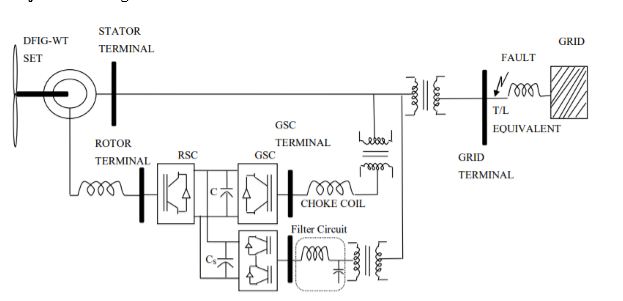
To meet the augmented load power demand, the doubly-fed induction generator (DFIG) based wind electrical power conversion system (WECS) is a better alternative. Further, to enhance the power flow capability and raise security margin in the power system, the STATCOM based FACTS devices can be adopted as an external reactive power source. In this paper, a three-level STATCOM is coordinated to the system with its dc terminal voltage is connected to the common back-to-back converters. Hence, a lookup table-based control scheme in the outer control loops is adopted in the Rotor Side Converter (RSC) and the grid side converter (GSC) of DFIG to improve power flow transfer and better dynamic as well as transient stability. Moreover, the DC capacitor bank of the STATCOM and DFIG converters connected to a common dc point sharing. This topology has advantages like improved real and reactive power flow control provided by the STATCOM, better reactive power support from RSC and GSC with nearly constant dc-link voltage maintenance. The main objectives of the work are to improve voltage mitigation, operation of DFIG during symmetrical and asymmetrical faults, and limit surge currents.
The results with 50%, 80% and 100% voltage dip are considered, the DFIG parameters like winding currents, torque, rotor speed are examined. Further, results with 30%, 60%, and 80% symmetrical voltage dip show the DFIG system performance with the proposed method. Also, zero-voltage fault ride through is investigated with proposed technique under symmetrical and asymmetrical LG fault for super synchronous (1.2 p.u.) speed and sub-synchronous (0.8 p.u.) rotor speed.
Finally, the system performance with different phases to ground faults like SLG, DLG, and TLG was applied and compared without and with a three-level STATCOM, with fault occurring at the point of common coupling with fault resistance of a minimal value of 0.001 ohms.
INDEX TERMS- Doubly-fed induction generator (DFIG), Field Oriented Control (FOC), common-capacitor based STATCOM, voltage compensation, balanced and unbalanced faults, and zero-voltage fault ride through.NOTE: Without the concern of our team, please don't submit to the college. This Abstract varies based on student requirements.
Block Diagram
Specifications
Software Configuration:
Operating System : Windows 7/8/10
Application Software : Matlab/Simulink
Hardware Configuration:
RAM : 8 GB
Processor : I3 / I5(Mostly prefer)
Learning Outcomes
- Introduction to Matlab/Simulink
- What is EISPACK & LINPACK
- How to start with MATLAB
- About Matlab language
- About tools & libraries
- Application of Matlab/Simulink
- About Matlab desktop
- Features of Matlab/Simulink
- Basics on Matlab/Simulink
- Introduction to controllers.
- Study of PWM techniques.
- Project Development Skills:
- Problem analyzing skills
- Problem solving skills
- Creativity and imaginary skills
- Programming skills
- Deployment
- Testing skills
- Debugging skills
- Project presentation skills
- Thesis writing skills


 Paper Publishing

Request Call Back
Would you like to receive a free callback now?
Choose the best time for callback:
Leave your message and we will contact you as soon as possible

6-2-85/B, Old Maternity Hospital Road, Thyagaraja Nagar, Tirupati, Andhra Pradesh – 517501
+91 9030333433
+91 9393939065
0877-2261612

Disclaimer - Takeoff Edu Group Projects are not associated or affiliated with IEEE in any way. The IEEE Projects mentioned here are mentioned in the context of student projects, whose ideas are derived from IEEE publications, not projects of or by IEEE.

