A Chaotic Reptile Search Algorithm for Energy Consumption Optimization in Wireless Sensor Networks
Objective
This study aims to develop a chaotic Reptile Search Algorithm for energy-efficient WSNs by optimizing cluster head selection, reducing energy consumption, and extending network lifetime compared to existing meta-heuristic approaches
Abstract
A wireless sensor network (WSN) relies on sensor nodes equipped with integrated processors to monitor and manage environmental conditions within a designated area. These nodes communicate with a base station (BS), which acts as the central processing unit of the entire system. WSNs face several challenges, including limited processing capability and short network lifetimes. To address the issue of network longevity, we propose a hybrid meta-heuristic (MH) optimization method called the Chaotic Reptile Search Algorithm (CRSA) for energy-efficient WSN operation. CRSA enhances the original Reptile Search Algorithm (RSA) by integrating chaotic maps. While RSA—like many meta-heuristic algorithms—can become trapped in local minima, the use of chaotic maps increases solution diversity and mitigates this issue. In WSNs, selecting optimal cluster heads (CHs) is crucial for conserving energy. The proposed CRSA identifies the most efficient set of cluster heads among the sensor nodes across the sensing field. We evaluate the performance of CRSA under various conditions and compare it with five different meta-heuristic algorithms and three variants of the Low-Energy Adaptive Clustering Hierarchy (LEACH) algorithm. Experimental results demonstrate that CRSA outperforms these existing methods in terms of total energy consumption, number of active nodes, packet reception at the base station, and overall network lifetime. These findings indicate that CRSA is a promising approach that achieves notable improvements over previously studied algorithms.
Keywords: Cluster Head Selection, Energy Consumption Optimization, Meta-heuristic (MH) Algorithms, Network Lifetime, Reptile Search Algorithm (RSA), Wireless Sensor Network (WSN).
NOTE: Without the concern of our team, please don't submit to the college. This Abstract varies based on student requirements.
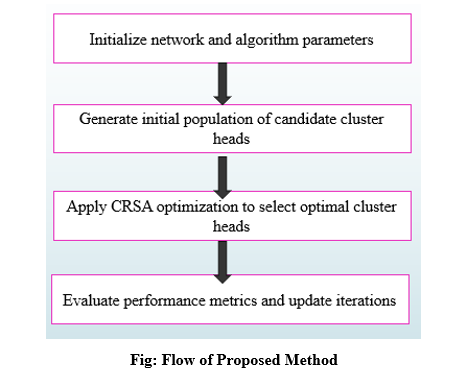
Block Diagram
Specifications
Software: Matlab 2022b or above
Hardware:
Operating Systems:
- Windows 10
- Windows 7 Service Pack 1
- Windows Server 2019
- Windows Server 2016
Processors:
Minimum: Any Intel or AMD x86-64 processor
Recommended: Any Intel or AMD x86-64 processor with four logical cores and AVX2 instruction set support
Disk:
Minimum: 2.9 GB of HDD space for MATLAB only, 5-8 GB for a typical installation
Recommended: An SSD is recommended A full installation of all MathWorks products may take up to 29 GB of disk space
RAM:
Minimum: 4 GB
Recommended: 8 GB
Learning Outcomes
· Introduction to Matlab
· What is EISPACK & LINPACK
· How to start with MATLAB
· About Matlab language
· Matlab coding skills
· About tools & libraries
· Application Program Interface in Matlab
· About Matlab desktop
· How to use Matlab editor to create M-Files
· Features of Matlab
· Basics on Matlab
· What is Communication?
· About Communication
· Introduction to Communication
· How Communication Works?
· Importing the System Design, Characterization and Visualization
· Analyzing of BER tool
· Analyzing of Error Rate Test Console
· Generation of WSN
· WSN network creation
· Nodes Communication
· Clustering
· Routing
· Convolutional
· Equalization and Synchronization etc.,
· How to extend our work to another real time applications
· Project development Skills
o Problem analyzing skills
o Problem solving skills
o Creativity and imaginary skills
o Programming skills
o Deployment
o Testing skills
o Debugging skills
o Project presentation skills
o Thesis writing skills
Demo Video


Request for Video
 Paper Publishing
Request Call Back
Would you like to receive a free callback now?
Choose the best time for callback:
Leave your message and we will contact you as soon as possible

6-2-85/B, Old Maternity Hospital Road, Thyagaraja Nagar, Tirupati, Andhra Pradesh – 517501
+91 9030333433
+91 9393939065
0877-2261612

Disclaimer - Takeoff Edu Group Projects are not associated or affiliated with IEEE in any way. The IEEE Projects mentioned here are mentioned in the context of student projects, whose ideas are derived from IEEE publications, not projects of or by IEEE.

