A Bipolar Voltage Gain Boost AC-AC Converter Based on Four Switching Transistors
Objective
The main objective of the project is bi polar gain boost ac-ac converter based on four switching transistors
Abstract
Abstract: In this project is AC voltage control schemes with one-stage conversion are viable approaches in this regard as only voltage regulation is needed. This conversion approach has strong potential for such applications as it is simple to realize. The voltage-correcting compensators are connected in series with the lines. The inputs of the AC voltage controllers employed in the voltage-correcting compensators may be connected to the faulty phase or other healthy phases. The number of AC voltage controllers used in a voltage compensator are one and two if its input power is drawn from the faulty and non-faulty phases, respectively. In the latter case, voltage gains and phase adjustment are major problems. There is no such issue in the first approach, where the voltage-correcting controller is connected to the line where the voltage variation is to be corrected. A high voltage gain more than the unity of both voltage polarities is required if the depth level of the correcting voltage is around 50% or more. The size and cost of a voltage-correcting controller depend on the number of switching transistors, as an isolated DC source with a gate-controlling circuit is a mandatory requirement for the switching operation of each transistor. Therefore, in the suggested research, an AC voltage controller having bipolar voltage gain is realized only with four switching transistors and six diodes, which reduces the overall size and cost significantly. The verification of the suggested topology is ensured by obtaining the simulation and real results from Simulink-based and practical-based platforms, respectively.
Keywords: voltage sag; voltage controller; voltage gain; switching transistors; non-inverting features; inverting features; faulty and non-faulty phase
NOTE: Without the concern of our team, please don't submit to the college. This Abstract varies based on student requirements.
Block Diagram
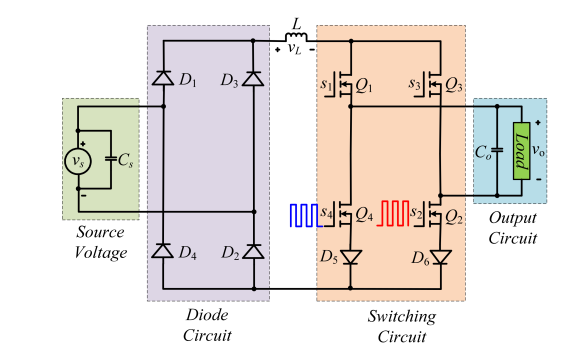
Specifications
Software Configuration:
Operating System : Windows 7/8/10
Application Software : Matlab/Simulink
Hardware Configuration:
RAM : 8 GB
Processor : I3 / I5(Mostly prefer)
Learning Outcomes
· Introduction to Matlab/Simulink
· What is EISPACK & LINPACK
· How to start with MATLAB
· About Matlab language
· About tools & libraries
· Application of Matlab/Simulink
· About Matlab desktop
· Features of Matlab/Simulink
· Basics on Matlab/Simulink
· We can learn about AC-AC Conversion topology
· We can learn about Inverted and Non-Inverted Outputs.
· We can learn about Controllers
Project Development Skills:
o Problem analyzing skills
o Problem solving skills
o Creativity and imaginary skills
o Programming skills
o Deployment
o Testing skills
o Debugging skills
o Project presentation skills
o Thesis writing skills
Demo Video


Request for Video
 Paper Publishing
Request Call Back
Would you like to receive a free callback now?
Choose the best time for callback:
Leave your message and we will contact you as soon as possible

6-2-85/B, Old Maternity Hospital Road, Thyagaraja Nagar, Tirupati, Andhra Pradesh – 517501
+91 9030333433
+91 9393939065
0877-2261612

Disclaimer - Takeoff Edu Group Projects are not associated or affiliated with IEEE in any way. The IEEE Projects mentioned here are mentioned in the context of student projects, whose ideas are derived from IEEE publications, not projects of or by IEEE.

