A 521pW, 0.016 V Line Sensitivity Self-Biased CMOS Voltage Reference With DIBL Effect Compensation Using Adaptive VGS Control
Objective
Achieving ultra-low power consumption – The design operates at just 521 pW, making it suitable for energy-constrained applications such as IoT devices and biomedical implants. Minimizing line sensitivity – The voltage reference achieves a line sensitivity of 0.016%/V, ensuring stable operation despite fluctuations in the power supply. Compensating for the Drain-Induced Barrier Lowering (DIBL) effect – A novel adaptive gate-source voltage VGS ? ) control technique is introduced to counteract variations caused by the DIBL effect, which is critical in deep-submicron CMOS technologies.
Abstract
This proposal presents an ultra-low-power self-biased CMOS voltage reference (SBCVR) that incorporates drain-induced-barrier-lowering (DIBL) effect compensation to enhance line sensitivity (LS) and low-frequency power supply rejection ratio (PSRR). To minimize the bias current (IB) dependence on the supply voltage (VDD) due to the DIBL effect, the gate-source voltage (VGS) of the biasing transistor is dynamically adjusted in response to VDD. This approach ensures compensation for the DIBL effect while maintaining IB's stability against variations in VDD. The SBCVR is implemented in a 0.18-μm CMOS process, and 18 samples were tested. The results demonstrate an average LS of 0.016%/V, which is approximately 85% lower than the version without DIBL compensation. The design also achieves a PSRR of −62.5dB at 10Hz. additionally, the average reference voltage (VREF) is 317.6mV, with a variation of 0.52% (σ/μ). The average temperature coefficient (TC) is 86.6 ppm/°Cover the range of 0°C to 100°C without trimming, and the minimum power consumption at 27°C is 521pW. The SBCVR, with DIBL compensation, occupies only 0.0016mm².
Key words:- —CMOS voltage reference, DIBL effect compensation, line sensitivity, power supply rejection ratio, self-biased, ultra-low power
NOTE: Without the concern of our team, please don't submit to the college. This Abstract varies based on student requirements.
Block Diagram
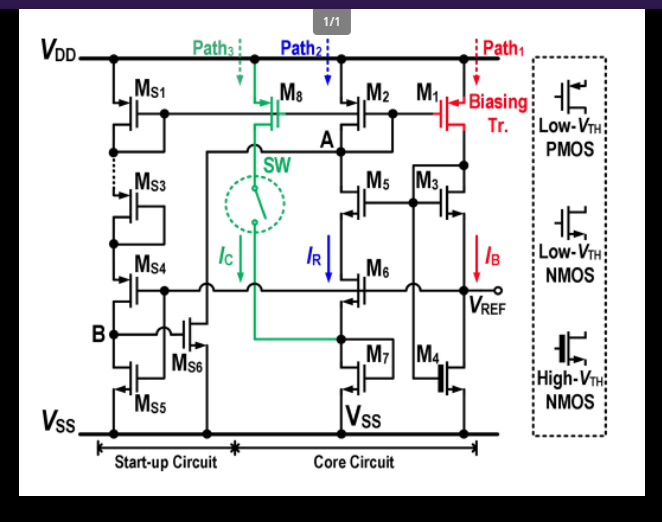
Specifications
Software Requirements:
- Tool: Cadence Virtuoso
- Technology: GPDK 180 nm
Hardware Requirements:
- Microsoft® Windows XP
- Intel® Pentium® 4 processor or Pentium 4 equivalent with SSE support
- 512 MB RAM
- 100 MB of available disk space
Learning Outcomes
· Introduction to Analog & Digital Electronics
· Amplifier Topology:
· SBVCR & DIBL:
· Adaptive VGS Control
· Circuit Analysis:
· Basics of operational amplifier:
· Operation of inverting amplifier:
· Biasing Techniques:
· Signal Integrity:


 Paper Publishing

Request Call Back
Would you like to receive a free callback now?
Choose the best time for callback:
Leave your message and we will contact you as soon as possible

6-2-85/B, Old Maternity Hospital Road, Thyagaraja Nagar, Tirupati, Andhra Pradesh – 517501
+91 9030333433
+91 9393939065
0877-2261612

Disclaimer - Takeoff Edu Group Projects are not associated or affiliated with IEEE in any way. The IEEE Projects mentioned here are mentioned in the context of student projects, whose ideas are derived from IEEE publications, not projects of or by IEEE.

