5G Coverage Prediction Identification of Dominant Feature Parameters and Prediction Accuracy
Objective
The primary objective of this research is to conduct a comparative analysis of various machine learning algorithms, including both traditional and advanced techniques, to predict 5G coverage accurately. By leveraging the RF Signal Data with Band Width as the target variable, the study aims to benchmark the performance of models such as Logistic Regression, KNN, Naive Bayes, Random Forest, SVM, XGBoost, LightGBM, AdaBoost, Bayesian Network Classifier, MLP, LSTM, Stacking, Voting Classifiers, and CNN. The goal is to identify the most accurate and computationally efficient model for practical deployment in 5G network optimization.
Abstract
In the era of 5G technology, predicting coverage areas is crucial for optimizing network performance and ensuring reliable connectivity. This study presents a comprehensive analysis of various machine learning algorithms for predicting 5G coverage based on the RF Signal Data. The target column, Band Width, is used to gauge prediction accuracy across different models. Traditional methods such as Logistic Regression, K-Nearest Neighbors (KNN), Naive Bayes, Random Forest, Support Vector Machine (SVM), XGBoost, LightGBM, AdaBoost, Bayesian Network Classifier, Multi-Layer Perceptron (MLP), and Long Short-Term Memory (LSTM) are evaluated against proposed advanced techniques like Stacking and Voting Classifiers, and Convolutional Neural Networks (CNN). The objective is to identify dominant feature parameters that significantly influence 5G coverage prediction. By implementing a diverse array of models, this research aims to benchmark the performance and accuracy of these algorithms. The comparative analysis highlights the strengths and limitations of each approach, providing valuable insights for network engineers and researchers. The findings suggest that ensemble methods, particularly Stacking and Voting Classifiers, along with CNN, offer superior prediction accuracy and robustness, thereby serving as promising tools for enhancing 5G network planning and deployment.
Keywords: 5G Coverage Prediction, Machine Learning, RF Signal Data, Stacking Classifier, Voting Classifier, Convolutional Neural Network (CNN), Feature Parameters, Prediction Accuracy, Network Optimization, Ensemble Methods.
NOTE: Without the concern of our team, please don't submit to the college. This Abstract varies based on student requirements.
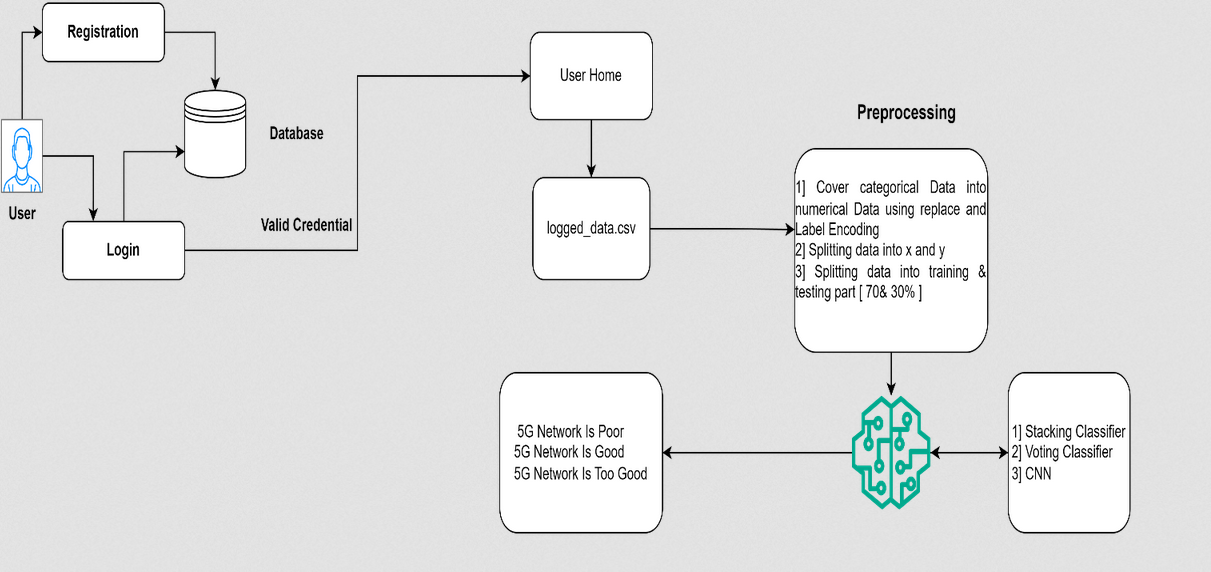
Block Diagram
Specifications
H/W SPECIFICATIONS:
· Processor : I5/Intel Processor
· RAM : 8GB (min)
· Hard Disk : 128 GB
· Key Board : Standard Windows Keyboard
· Mouse : Two or Three Button Mouse
· Monitor : Any
S/W SPECIFICATIONS:
• Operating System : Windows 7+
• Server-side Script : Python 3.6+
• IDE : PyCharm / VSCode
• Libraries Used : Pandas, Numpy, Matplotlib, OS.


 Paper Publishing

Request Call Back
Would you like to receive a free callback now?
Choose the best time for callback:
Leave your message and we will contact you as soon as possible

6-2-85/B, Old Maternity Hospital Road, Thyagaraja Nagar, Tirupati, Andhra Pradesh – 517501
+91 9030333433
+91 9393939065
0877-2261612

Disclaimer - Takeoff Edu Group Projects are not associated or affiliated with IEEE in any way. The IEEE Projects mentioned here are mentioned in the context of student projects, whose ideas are derived from IEEE publications, not projects of or by IEEE.

