32-bit RISC-V Processor with Switchable Floating Point ALU
Objective
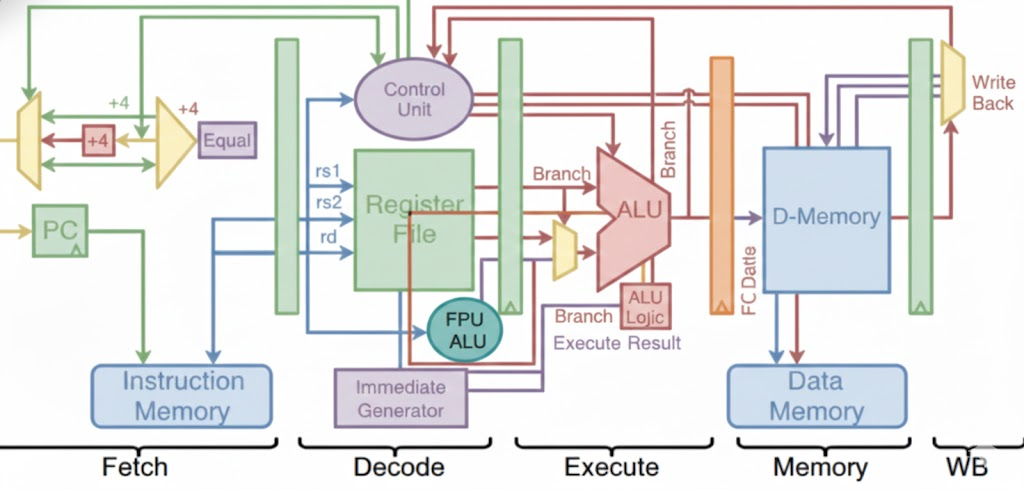
The 32-bit RISC-V processor with a five-stage pipeline and a switchable floating-point ALU (FPU) is a high- performance and power-efficient computing architecture designed for modern applications requiring both integer and floating-point computations.
Abstract
This project presents the design and implementation of a 32-bit RISC-V processor featuring a switchable Floating-Point Arithmetic Logic Unit (FP-ALU) for enhanced computational flexibility. The processor is based on the RV32I instruction set architecture and supports both integer and floating-point operations through a configurable execution pipeline. The switchable FP-ALU allows dynamic selection between integer ALU mode and IEEE-754–compliant floating-point mode, enabling efficient execution of arithmetic-intensive applications without compromising hardware simplicity. The architecture includes optimized modules for instruction fetch, decode, register file, ALU, FP-ALU, control unit, and pipeline hazard management. The processor is described in Verilog HDL and synthesized on an FPGA to evaluate performance, area, and power. Experimental results demonstrate significant improvements in throughput for floating-point workloads while maintaining low resource utilization. The proposed design provides a balanced trade-off between performance and hardware cost, making it suitable for embedded, IoT, and signal-processing applications requiring mixed-precision computation. To maintain smooth pipeline flow, techniques like hazard detection, stalling, and forwarding are used to minimize delays. The complete design is written in Verilog HDL and synthesized, simulated, and tested using the Vivado design suite on FPGA hardware.
Keywords: - RISC-V Processor, 5-Stage Pipeline, Verilog HDL, Vivado, integer ALU, floating-point ALU, FPGA Implementation.
NOTE: Without the concern of our team, please don't submit to the college. This Abstract varies based on student requirements.
Block Diagram
Specifications
Specifications:
Software Requirements:
· VIVADO 2018.3
Hardware Requirements:
· Microsoft® Windows XP
· Intel® Pentium® 4 processor or Pentium 4 equivalent with SSE support
· 512 MB RAM
· 100 MB of available disk space
Learning Outcomes
- Understand the concept of arthimetic computing and its trade-offs for power and accuracy.
- Gain skills in designing multipliers for energy-efficient digital systems.
- Analyze trade-offs between accuracy, power, delay, and area.
- Implement and simulate digital arithmetic units using Verilog/VHDL.
- Apply arithmetic in real-time error-tolerant applications such as image processing and IoT.


 Paper Publishing

Request Call Back
Would you like to receive a free callback now?
Choose the best time for callback:
Leave your message and we will contact you as soon as possible

6-2-85/B, Old Maternity Hospital Road, Thyagaraja Nagar, Tirupati, Andhra Pradesh – 517501
+91 9030333433
+91 9393939065
0877-2261612

Disclaimer - Takeoff Edu Group Projects are not associated or affiliated with IEEE in any way. The IEEE Projects mentioned here are mentioned in the context of student projects, whose ideas are derived from IEEE publications, not projects of or by IEEE.

