±0.25-V Class-AB CMOS Capacitance multiplier and precision rectifiers
Objective
A high-performance capacitance multiplier able to operate with supplies as low as ±0.25 V is presented. It is based on adaptively biased class-AB current mirrors which provide high current efficiency.
Abstract
Reducing the minimum supply requirements plays a vital role in minimizing power consumption in VLSI systems. This article presents a highly efficient capacitance multiplier that can operate with supplies as low as ±0.25 V. The design is centred around adaptively biased class-AB current mirrors, which offer excellent current efficiency. Experimental measurements conducted on a capacitance multiplier with a factor of 11, fabricated using 180-nm CMOS technology, validate the theoretical claims. Additionally, the same class-AB current mirrors are employed in the design and fabrication of low-voltage precision rectifiers using the same CMOS process. These rectifiers generate output currents over 100 times greater than the quiescent current. Both circuits proposed in this study exhibit a static power dissipation of only 300 nW when operating with ±0.25 V supplies.
Keywords: —— Capacitance multiplier, class-AB current mirror, low supply voltage, precision rectifiers.
NOTE: Without the concern of our team, please don't submit to the college. This Abstract varies based on student requirements.
Block Diagram
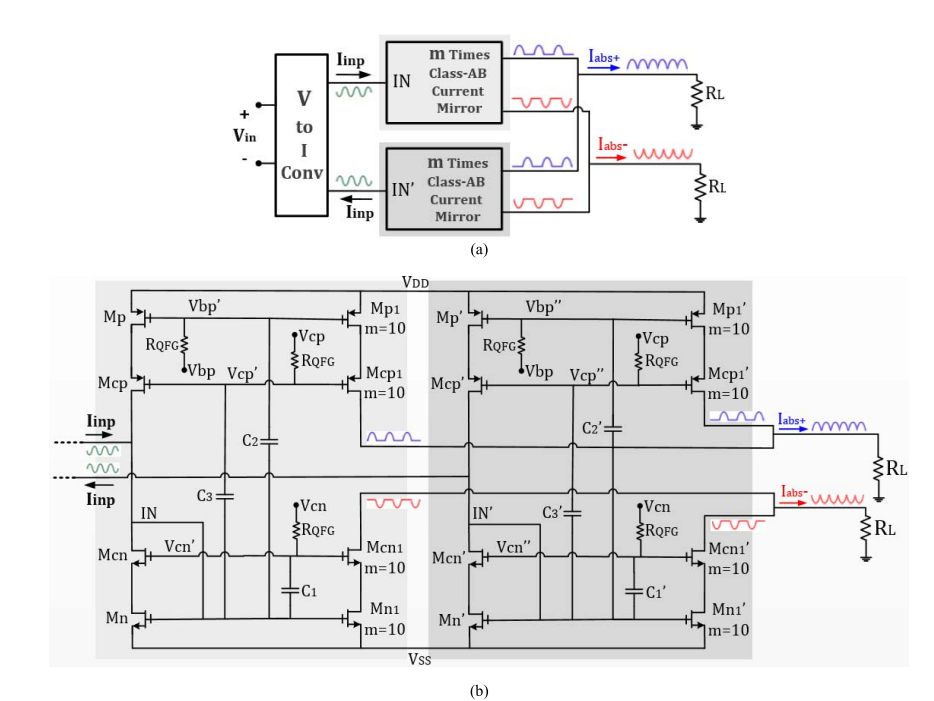
Specifications
Software Requirements:
· Cadence virtuoso
· Technology files: 180nm
Hardware Requirements:
· Microsoft® Windows XP
· Intel® Pentium® 4 processor or Pentium 4 equivalent with SSE support
· 512 MB RAM
· 100 MB of available disk space
Learning Outcomes
- Introduction to Digital electronics
- Introduction of Amplifiers
- Precision rectifiers
- Importance of Transistors
- MOS Fundamentals
- NMOS/PMOS/CMOS Technologies
- How to design circuits using Transistor logic?
- Scope of multipliers in today’s world
- Applications in Real time.
- Cadence for design and simulation
- Solution providing for real time problems
- Project Development Skills:
- Problem Analysis Skills
- Problem Solving Skills
- Logical Skills
- Designing Skills
- Testing Skills
- Debugging Skills
- Presentation skills
- Thesis Writing Skills


 Paper Publishing

Request Call Back
Would you like to receive a free callback now?
Choose the best time for callback:
Leave your message and we will contact you as soon as possible

6-2-85/B, Old Maternity Hospital Road, Thyagaraja Nagar, Tirupati, Andhra Pradesh – 517501
+91 9030333433
+91 9393939065
0877-2261612

Disclaimer - Takeoff Edu Group Projects are not associated or affiliated with IEEE in any way. The IEEE Projects mentioned here are mentioned in the context of student projects, whose ideas are derived from IEEE publications, not projects of or by IEEE.

