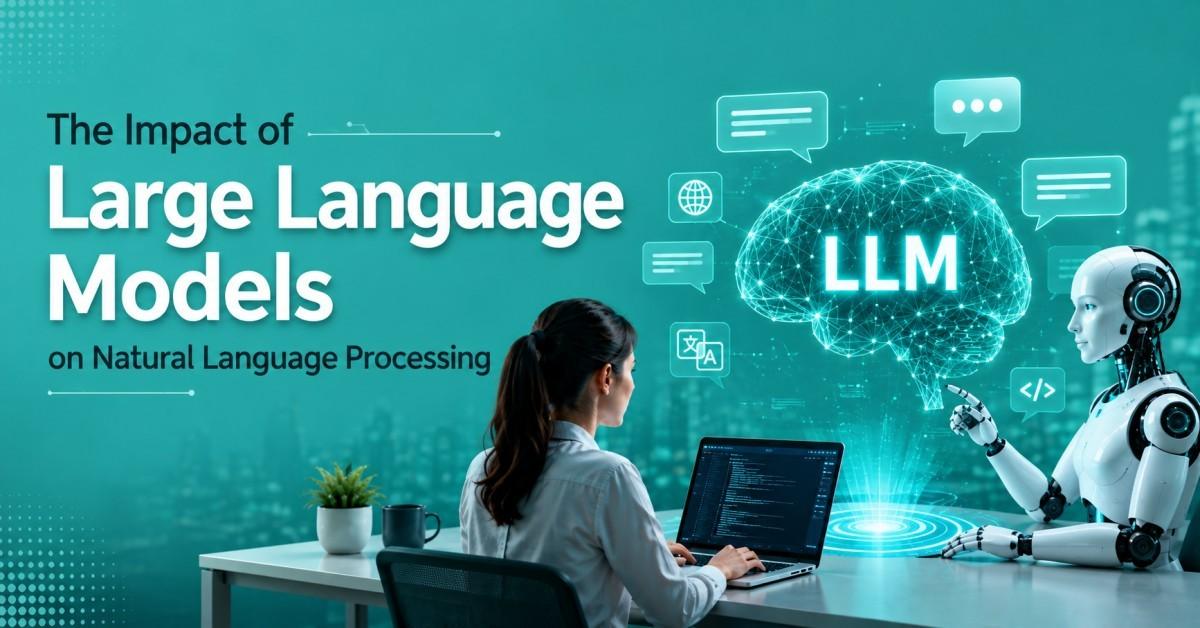

Introduction
Large Language Models (LLMs) have transformed the field of Natural Language Processing (NLP) by enabling computers to understand, generate, and process human language with greater accuracy and flexibility. Traditional NLP systems were often designed for specific tasks and required large amounts of labeled data. LLMs, however, can perform multiple language-related tasks using their understanding of patterns learned from massive datasets.
Models based on transformer architectures have significantly improved applications such as machine translation, text summarization, question answering, content generation, sentiment analysis, and conversational AI. As a result, LLMs have become an important technology for modern NLP applications across industries.
What Are Large Language Models?
Large Language Models are advanced artificial intelligence models trained on large collections of text. They learn relationships between words, phrases, sentences, and concepts, allowing them to predict and generate meaningful language.
LLMs can understand context and respond to prompts in a human-like manner. Unlike traditional NLP models that may be trained for one particular task, modern LLMs can support multiple tasks within the same model.
How LLMs Have Changed NLP
LLMs have introduced several major improvements to NLP:
- Better understanding of context and language patterns
- Improved ability to generate natural and coherent text
- Support for multiple NLP tasks using a single model
- Better handling of complex and lengthy queries
- Reduced dependence on task-specific training
- Improved multilingual language processing
- More natural human-computer interaction
These capabilities have made NLP systems more versatile and useful in real-world applications.
Impact of LLMs on Machine Translation
Machine translation is one of the major areas influenced by LLMs. Traditional translation systems often depended heavily on predefined linguistic rules or specialized training for specific language pairs.
LLMs can analyze the context of a sentence before generating its translation. This helps them produce more natural translations and handle differences in grammar, word meaning, and sentence structure.
LLMs can also support multiple languages within a single model, making multilingual applications easier to develop.
Impact on Text Summarization
LLMs have significantly improved automatic text summarization. They can process large amounts of information and generate concise summaries while attempting to preserve the most important ideas.
For example, an LLM can summarize:
- Research papers
- News articles
- Business reports
- Meeting transcripts
- Educational content
- Customer feedback
This can help users quickly understand lengthy documents without reading every section.

Impact on Question Answering
Question answering has also been transformed by LLMs. Instead of simply matching keywords with predefined answers, LLMs can interpret the meaning and context of questions and generate relevant responses.
They can answer questions in conversational language, explain concepts, summarize information, and provide step-by-step explanations. This has contributed to the development of intelligent chatbots, virtual assistants, educational tools, and customer-support systems.
LLMs and Conversational AI
The ability of LLMs to understand context and generate human-like responses has accelerated the growth of conversational AI.
Modern AI assistants can be used for:
- Customer support
- Virtual assistance
- Education and tutoring
- Content creation
- Technical support
- Business communication
LLMs allow these systems to maintain more natural conversations compared with many traditional rule-based chatbots.
Benefits of LLMs in NLP
The major benefits of using LLMs in NLP include:
1. Improved Language Understanding
LLMs can analyze context and relationships between different parts of text.
2. Versatility
A single model can perform several NLP tasks, including translation, summarization, question answering, and text generation.
3. Better User Interaction
LLMs make interactions with AI systems more conversational and natural.
4. Multilingual Capabilities
Many LLMs can process and generate content in multiple languages.
5. Increased Productivity
LLMs can automate repetitive language-based tasks and help users process information faster.
Challenges and Limitations
Despite their advantages, LLMs also have limitations. They may sometimes generate incorrect or misleading information, commonly referred to as hallucinations. Their performance can also depend heavily on the quality and clarity of the input provided.
Other challenges include:
- High computational requirements
- Data and privacy concerns
- Potential biases in training data
- Difficulty verifying generated information
- High costs associated with training and deployment
- Challenges in understanding highly specialized or ambiguous content
Therefore, human oversight and responsible AI practices remain important when using LLM based NLP systems.
Future of LLMs in NLP
The future of LLMs in NLP is expected to focus on improving accuracy, efficiency, reasoning capabilities, multilingual support, and domain specific applications. Smaller and more efficient models may make advanced NLP technologies accessible to more organizations and devices.
LLMs are also likely to become increasingly integrated with search systems, business applications, education platforms, healthcare tools, customer-service systems, and other intelligent applications.
👉 Also Read: Learn More About This Topic in Our Blog
Also Read: https://takeoffprojects.com/page/blog/exploring-the-future-of-llms
Conclusion
Large Language Models have revolutionized Natural Language Processing by improving how machines understand, generate, translate, summarize, and respond to human language. Their ability to perform multiple tasks within a single model has made NLP applications more flexible and powerful.
Although challenges such as hallucinations, bias, privacy, and computational costs remain, continued advancements in LLM technology are expected to make NLP systems more accurate, efficient, and useful. As these models continue to evolve, they will play an increasingly important role in the future of artificial intelligence and human computer interaction.
 Computer Science Projects: A Step-by-Step Guide for Students
  An Introduction to Deep Learning: Understanding Neural Networks
  What is Agentic AI? Understanding Autonomous Decision-Making in AI Systems
  Confused About Choosing Data Science Projects for Final Year? Here's Everything You Need to Know
  What Are the Best Natural Language Processing Projects for Final Year Students?
  Top 10 Machine Learning Final Year Projects for Engineering Students
  How to Choose AI Projects for Students for Your Final Year Project?
  Exploring the Future of LLMs: What’s next for AI in Language Understanding?
  What is Generative AI? A Complete Guide to Its Technology and Applications
  Artificial Intelligence Projects in Python with Complete Project Support
  Trending Data Mining Projects for BTech Students in 2026
  100+ Machine Learning Projects & Ideas for Students
  Top 10 Innovative AI Project Ideas for Final Year Students
  Explainable Artificial Intelligence (XAI) in the Era of Black Box Foundation Models
  Personalized AI Companions: A new wave of Emotional Intelligence in GenAI
  Responsible GenAI: Guardrails, Bias Control, and Alignment Techniques
  Synthetic Data Generation for Training Robust AI Models
  GenAI for Software Development: Code Generation, Refactoring & Debugging
  Agentic AI: The Rise of Multi-Agent Autonomous Systems
  Machine Learning Projects
  Fine-Tuning Llama 4 A Guide With Demo Project
  Top Advanced Machine Learning Projects for 2025
  Machine Learning Projects for Final Year Students
  Computer Science Projects
  ML Projects for Final Year
  Project Ideas for BTech CSE
  Mini Projects for Computer Science
  Major Project for CSE
  IEEE Projects for CSE
  Latest CSE Projects Ideas & Topics for Engineering Students
  List of Final Year Projects for Computer Science
  Top 6 Computer Science Engineering Projects































 Paper Publishing




