Advanced M.Tech CSE Project
Implementation & Thesis Write-up Support
Expert-led implementation for computer science students. We deliver 100% IEEE-standard research projects, plagiarism-free dissertations, and end-to-end coding support for advanced computational models.
Advanced Major Projects & IEEE Dissertation Domains
Rigorous, base-paper-driven architectures designed for final-year thesis evaluation and international publication.
AI & Machine Learning
Deep neural networks, reinforcement learning, and explainable AI systems built on the latest IEEE papers.
Generative AI & Computer Vision
Cutting-edge GenAI pipelines and vision systems with real-world deployment capabilities.
Cloud Computing & Big Data
Scalable distributed architectures using leading cloud platforms and big data processing frameworks.
Cybersecurity & Blockchain
Next-gen decentralized systems and security architectures for modern threat landscapes.
IoT & Edge Computing
Smart device networks with edge intelligence for latency-critical real-time applications.
NLP & Text Intelligence
Advanced language models for semantic understanding, generation, and multi-domain classification.
High-Impact Mini Projects & Fast-Track Solutions
Perfect for semester evaluations, internships, and skill demonstrations. Fast turnaround, clean code, and easy-to-explain logic.
Applied Data Science
- Student Performance Predictor
- E-commerce Sentiment Analyzer
- Real Estate Price Forecasting
Web & Cloud Applications
- Secure Cloud File Sharing App
- Automated Attendance System API
- Task Management Dashboard
Basic Computer Vision
- Real-time Mask Detection System
- Automated Number Plate Recognition
- Facial Emotion Tracker
Applied Security
- Password Strength Analyzer
- Basic Steganography Tool
- Secure Chat Application
Comprehensive Academic Documentation Support
We don't just complete work — we perfect it. Expert writers and domain researchers covering every niche CSE subject.
Deep Learning & NLP
- Optimizing CNNs for Edge Devices
- Transformer Models for Sentiment Analysis
- Federated Learning for Privacy Preservation
IoT & Edge Computing
- Energy-Efficient Resource Provisioning
- Distributed Architecture for Smart Cities
- Fog Computing for Real-Time Systems
Advanced Cryptography
- Zero-Knowledge Proofs for Decentralized Identity
- Quantum-Resistant Encryption Protocols
- Homomorphic Encryption in Cloud Systems
Literature Review
Synthesizing recent IEEE & ACM papers to establish clear research gaps.
Methodology & Design
Precise pseudo-code and flowcharts for evaluation committees.
Result Analysis
Graphical accuracy, precision, and recall metrics using Python or MATLAB.
Plagiarism Compliance
Similarity below 10% with official Turnitin reports included.
Viva Presentation
Professional PowerPoint and Q&A preparation for your defense.
Our 5-Step Project & Thesis Workflow
A clear, student-friendly process that ensures timely submission and academic excellence.
Topic Finalization
Selection based on recent 2025/2026 IEEE transactions and your university requirements.
Environment Setup
Configuring IDEs including Jupyter, VS Code, and Google Colab for your stack.
Module Development
Step-by-step coding with detailed walkthroughs so you understand every module.
Validation & Testing
Rigorous validation against standard Kaggle & UCI benchmark datasets.
Viva Preparation
Code walkthroughs, Q&A sessions, and professional PowerPoint creation.
Why Students Choose Us
Every project goes through strict quality checks before delivery.
Save Time & Reduce Stress
Focus on learning while we handle the implementation and documentation from end to end.
100% Original Content
All work is freshly written and coded — never recycled, never resold, never templated.
Domain Experts & Researchers
Specialized engineers with active research backgrounds in each technical area.
Unlimited Free Revisions
We iterate until you're completely satisfied — no extra charge for any revisions needed.
IEEE-Compliant Standards
All projects built on recent peer-reviewed IEEE base papers ensuring academic authenticity.
Complete Source & Datasets
Full source code, libraries, and datasets from Kaggle and UCI with explanatory walkthroughs.
Behind the Code: Recent CSE Implementations
Real-world architectures and complex problem-solving delivered for recent M.Tech students.
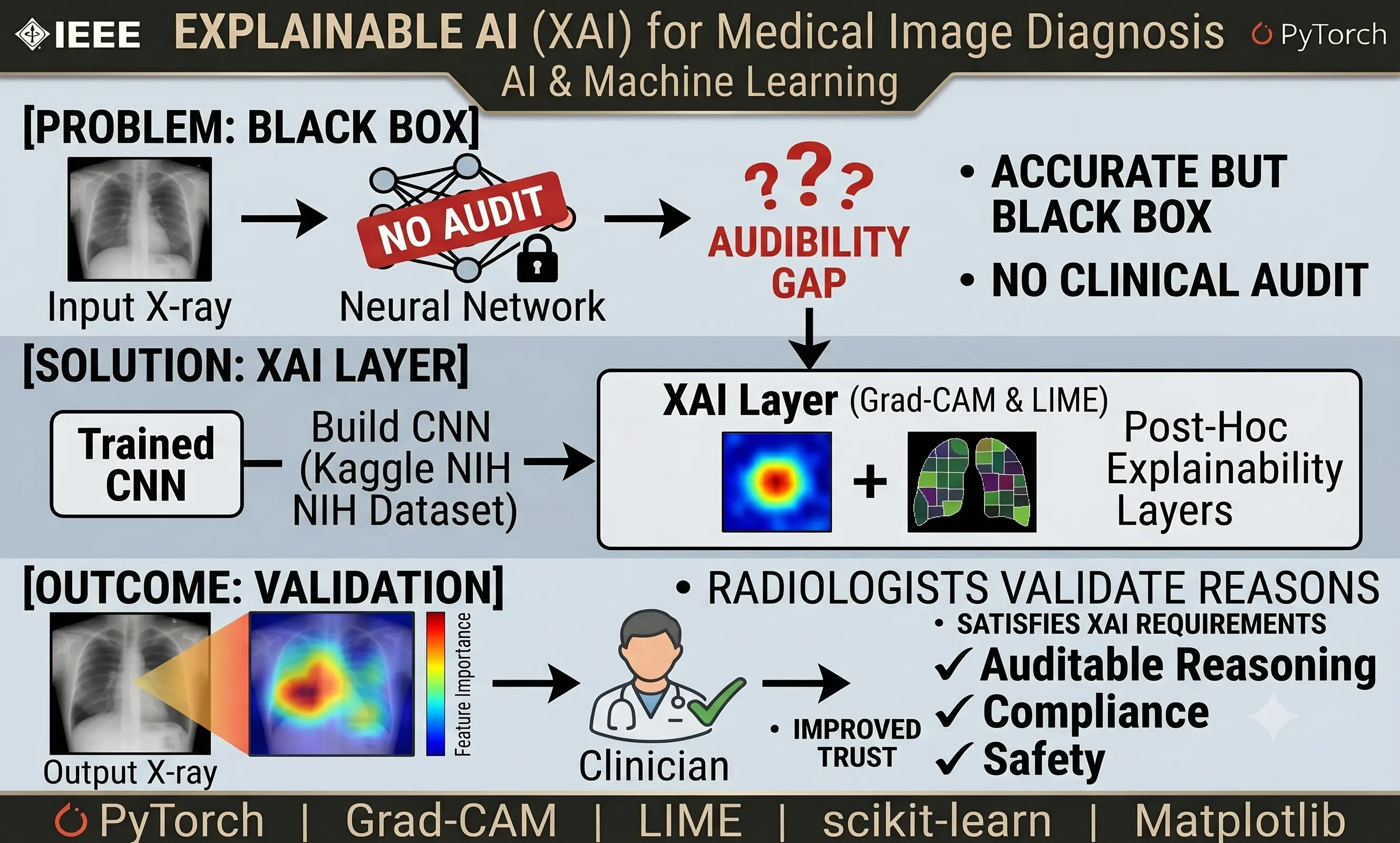
Explainable AI for Medical Image Diagnosis
Deep neural networks deliver strong diagnostic accuracy on medical images but lack transparency, making clinical trust and regulatory approval difficult. This project built a CNN-based chest X-ray classifier and layered Grad-CAM and LIME explainability techniques on top, generating pixel-level saliency heatmaps overlaid on original images. Radiologists can now visually validate exactly which regions drive each prediction, bridging the gap between model performance and clinical accountability.
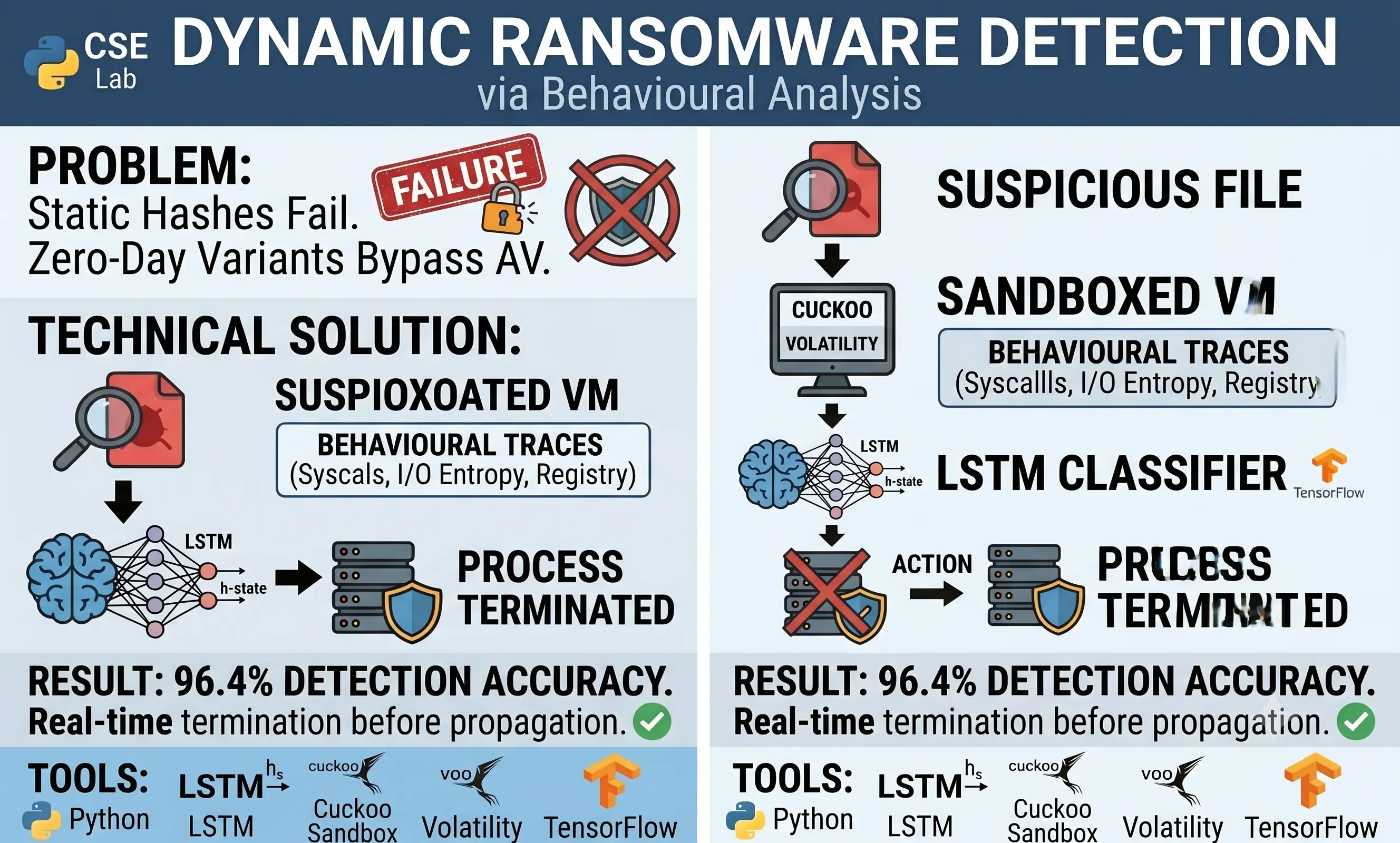
Dynamic Ransomware Detection via Behavioural Analysis
Signature-based antivirus tools are trivially bypassed by polymorphic and zero-day ransomware, leaving enterprise systems vulnerable to rapid, large-scale encryption attacks. This project built a dynamic analysis pipeline that runs ransomware samples inside a sandboxed VM, capturing system calls, file I/O entropy, and registry patterns as behavioral fingerprints. An LSTM classifier trained on these traces achieves 96.4% detection accuracy and triggers real-time process termination before encryption can spread beyond its initial target.
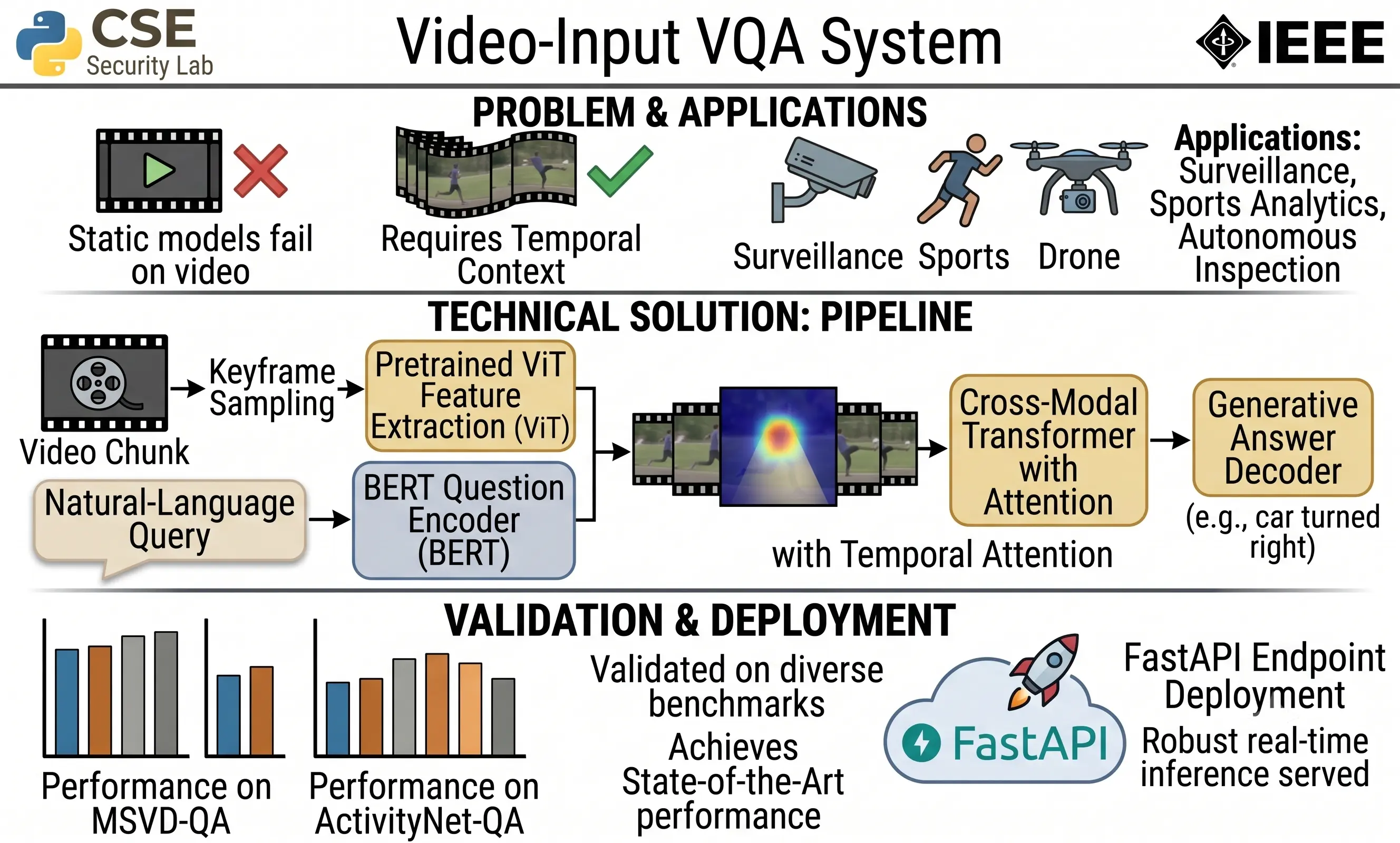
Video-Input Visual Question Answering System
Standard VQA systems only process static images, falling short in real-world scenarios like surveillance or sports analytics where context evolves across time. This project combines a Vision Transformer for per-frame feature extraction with a BERT-based question encoder, using a cross-modal transformer to reason over temporal keyframe sequences. The resulting system answers natural-language queries about video content and is served through a FastAPI endpoint, benchmarked on MSVD-QA and ActivityNet-QA.
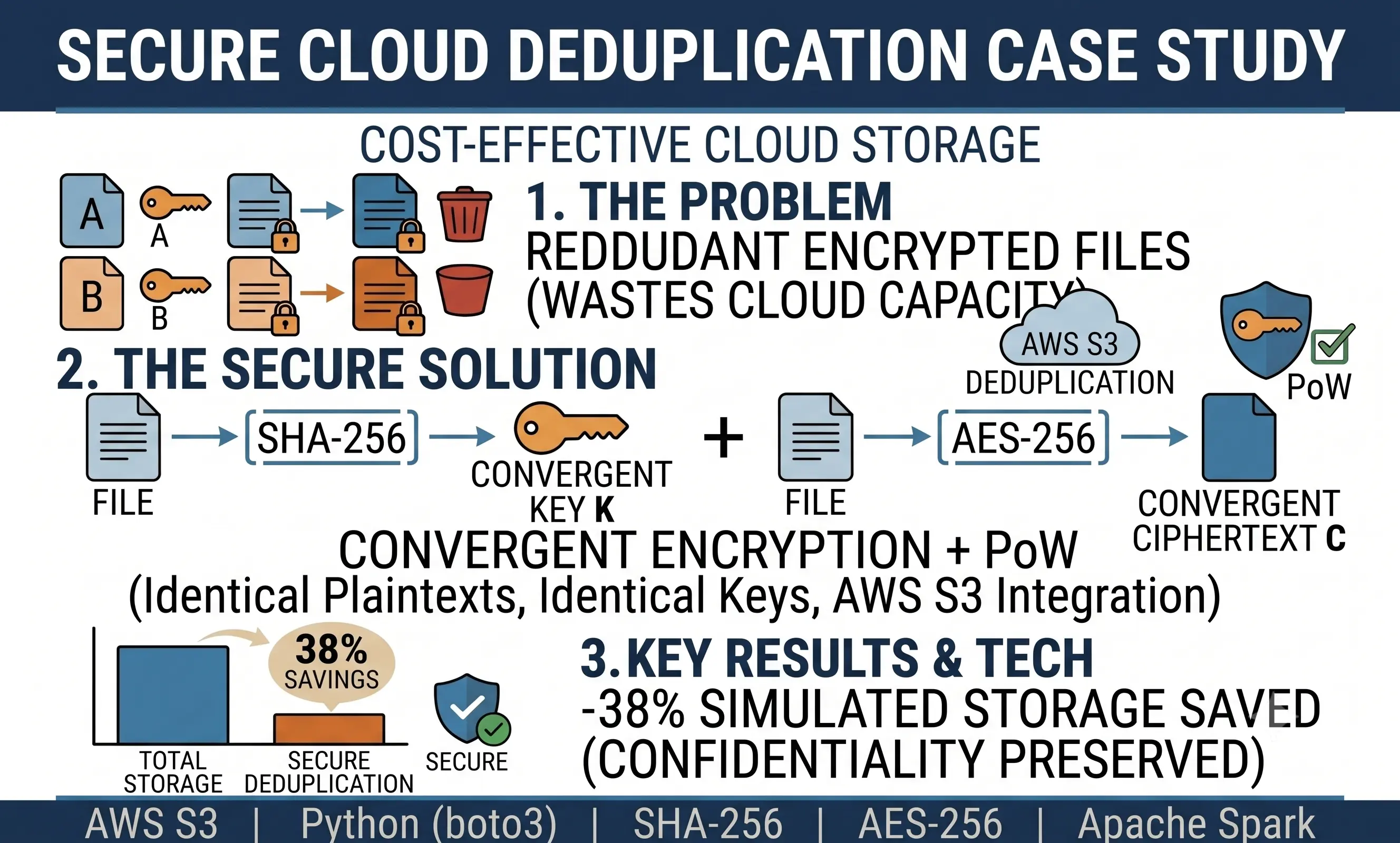
Secure Deduplication of Encrypted Cloud Data
Cloud providers cannot deduplicate encrypted files because identical plaintexts produce different ciphertexts under user-specific keys, wasting significant storage capacity. This project implements convergent encryption on AWS S3, where file content is hashed via SHA-256 to deterministically derive encryption keys — enabling server-side deduplication while preserving confidentiality. A proof-of-ownership challenge layer prevents hash enumeration attacks, cutting simulated storage overhead by 38% across the test corpus.
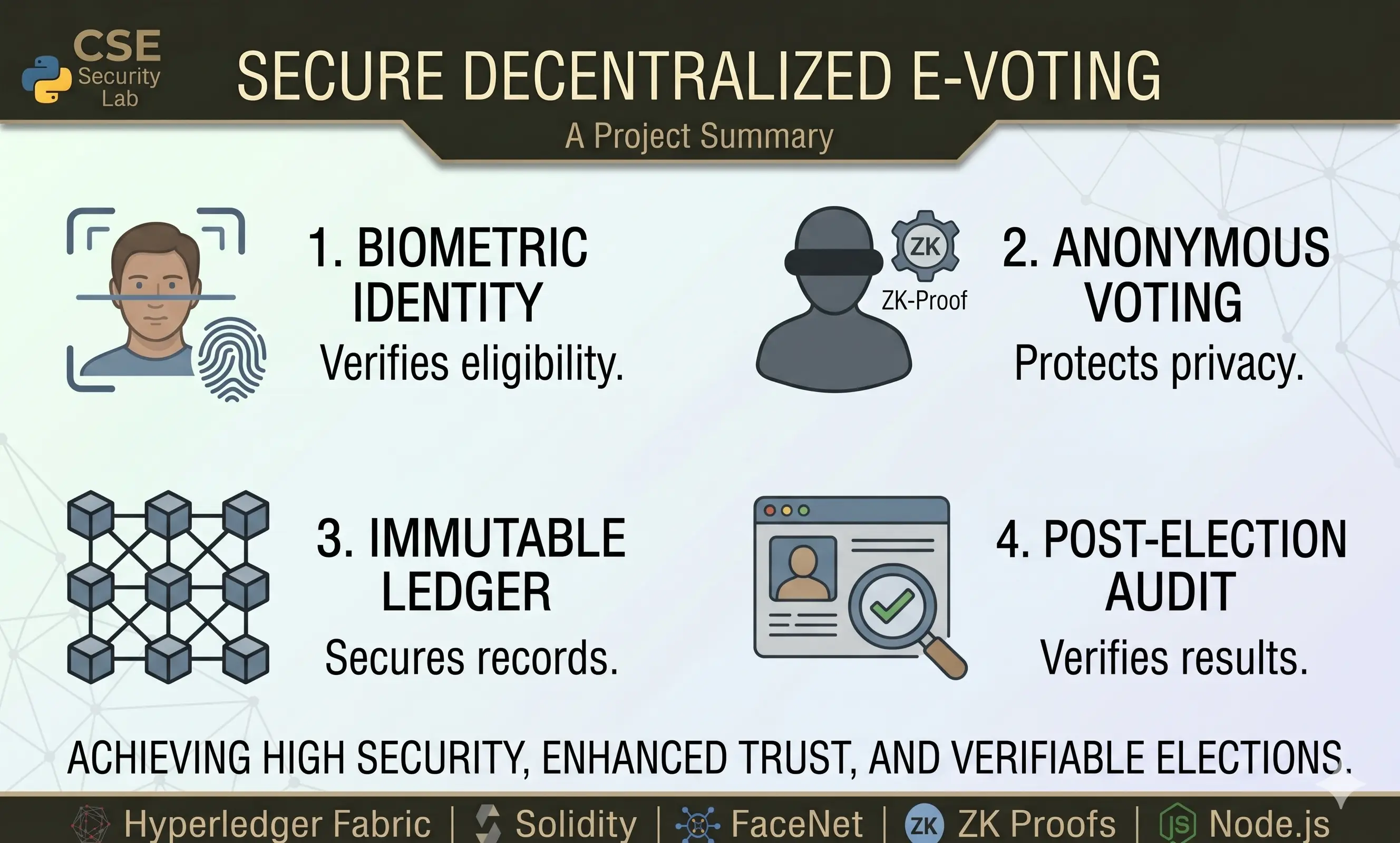
Decentralized E-Voting with Biometric Authentication
Centralized voting platforms are prone to manipulation, DDoS attacks, and audit disputes, while simultaneously struggling to reconcile voter anonymity with verifiable identity. This project deploys a permissioned Hyperledger Fabric network where voter identity is bound to a FaceNet biometric hash referenced on-chain via zero-knowledge commitments — confirming eligibility without exposing identity. All ballots are stored as immutable ledger entries, making every election fully auditable by any stakeholder after the fact.
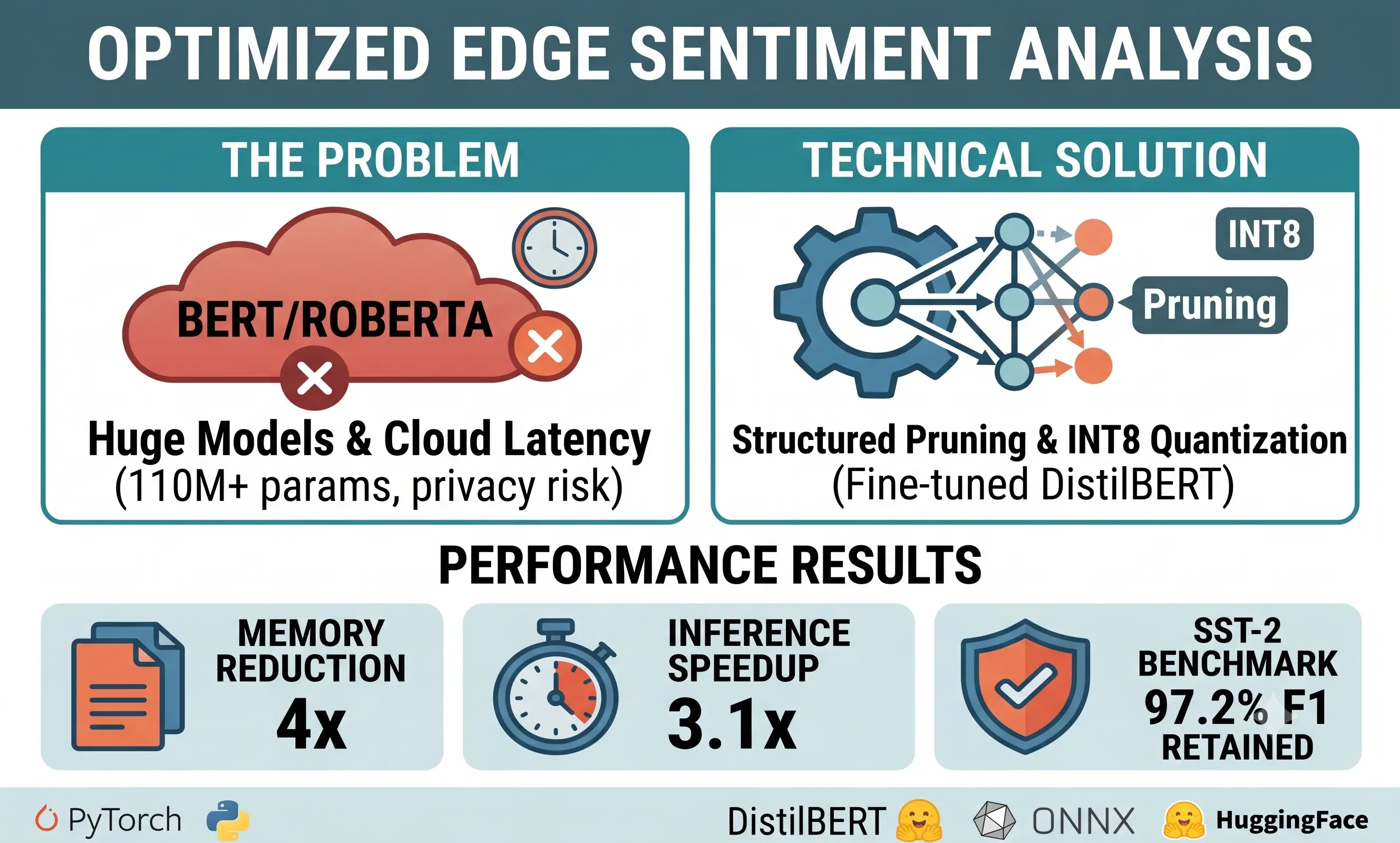
Optimized Transformer for Sentiment Analysis on Edge Devices
Large language models like BERT are too computationally demanding to run on edge hardware, creating latency and privacy drawbacks when cloud inference is required. This project applies structured pruning and INT8 quantization to a fine-tuned DistilBERT model, achieving a 4× memory reduction and 3.1× inference speedup on ARM Cortex-A72 hardware. The compressed model retains 97.2% of its original F1 score on SST-2 and is exported via ONNX for cross-platform edge deployment.
What Our Clients Say
M.Tech students who successfully defended their theses and secured their degrees with our expert assistance.
"I spent almost three weeks trying to identify a clear research gap for my deep learning thesis and kept getting rejected by my guide. The consultants helped me analyse recent IEEE papers on CNN optimization, showed me where the existing models lacked efficiency for edge devices, and helped structure a proper research proposal. After that the implementation using Python and TensorFlow became much easier. My guide approved the topic immediately once the methodology was properly framed."
"My project was based on network intrusion detection using machine learning, but during testing my model accuracy was inconsistent and the demo kept failing. The team helped restructure the data pre-processing, feature selection, and model training pipeline in Scikit-learn. They also showed me how to present the confusion matrix and accuracy metrics clearly in the results chapter. The biggest relief was that the system worked smoothly during my final demonstration."
"I chose a blockchain-based secure voting system, but honestly I didn’t fully understand how to explain the architecture to my panel. The team simplified the entire workflow — smart contract logic, transaction validation, and node interaction. They also helped prepare diagrams and the explanation slides for my viva. When I presented the project, I could confidently walk through every module instead of just showing the output."
"I had completed most of my IoT data processing project, but the thesis writing part was overwhelming. They helped convert my raw work into a structured dissertation with literature review, methodology diagrams, experimental results, and proper IEEE citations. They even helped generate the accuracy and latency graphs using Python plots for the evaluation chapter. The final document looked like an actual research thesis rather than just a project report."
"I needed a quick but technically solid mini project for my semester evaluation, and I didn’t want something too basic. The team suggested a sentiment analysis system using Python, Pandas, and NLP libraries. They explained the tokenization process, feature extraction, and classification model clearly. Because of that I could demonstrate both the working system and the underlying logic during the review."
"I contacted them when I was almost out of time to complete my computer vision project using OpenCV. My code had several runtime issues and the dataset pre-processing was incomplete. They fixed the errors, optimized the detection pipeline, and helped me understand the workflow step by step. Even under the tight deadline, the project was completed with proper documentation and I was able to submit without any last-minute stress."
Frequently Asked Questions
Everything you need to know before getting started.
Don't let deadlines or complex tasks stress you out.
Get expert help and boost your academic success today. Free consultation available.
 Paper Publishing

Request Call Back
Would you like to receive a free callback now?
Choose the best time for callback:
Leave your message and we will contact you as soon as possible

6-2-85/B, Old Maternity Hospital Road, Thyagaraja Nagar, Tirupati, Andhra Pradesh – 517501
+91 9030333433
+91 9393939065
0877-2261612

Disclaimer - Takeoff Edu Group Projects are not associated or affiliated with IEEE in any way. The IEEE Projects mentioned here are mentioned in the context of student projects, whose ideas are derived from IEEE publications, not projects of or by IEEE.

