LUT-based Energy-efficient Approximate Multiplier for more Sustainable Neural Network Applications
Objective
The increasing use of artificial intelligence in realworld applications has intensified the energy demands of computing systems, turning power consumption into a critical concern. In this paper, a scalable lookup table (LUT)-based approximate multiplier, called LUTEA, is proposed for low power and sustainable computing. LUTEA employs static segmentation to uniformly partition input operands and extracts the segment containing the leading one bit (LOB) to compute the most significant portion of the result. A lightweight LUT is incorporated to compensate for truncation error at low cost. Synthesized in a 45nm technology, LUTEA achieves 60.6% area reduction and 74.1% energy savings compared to an exact 8-bit Wallace multiplier, and up to 53.6% and 65.2% improvements, respectively, over state-of-the-art approximate designs. The proposed multiplier is evaluated in image processing and deep neural network (DNN) applications, demonstrating excellent error tolerance.
Abstract
The increasing use of artificial intelligence in realworld applications has intensified the energy demands of computing systems, turning power consumption into a critical concern. In this paper, a scalable lookup table (LUT)-based approximate multiplier, called LUTEA, is proposed for low-power and sustainable computing. LUTEA employs static segmentation to uniformly partition input operands and extracts the segment containing the leading one bit (LOB) to compute the most significant portion of the result. A lightweight LUT is incorporated to compensate for truncation error at low cost. Synthesized in a 45nm technology, LUTEA achieves 60.6% area reduction and 74.1% energy savings compared to an exact 8-bit Wallace multiplier, and up to 53.6% and 65.2% improvements, respectively, over state-of-the-art approximate designs. The proposed multiplier is evaluated in image processing and deep neural network (DNN) applications, demonstrating excellent error tolerance. The SSIM and PSNR image quality metrics reach 0.99 and 44 dB, respectively, while DNN experiments show minimal accuracy loss. The maximum observed DNN accuracy degradation is 2.49% for classification of CIFAR-10 using ResNet-18, which can be reduced to 0.36% by just one epoch of retraining.
NOTE: Without the concern of our team, please don't submit to the college. This Abstract varies based on student requirements.
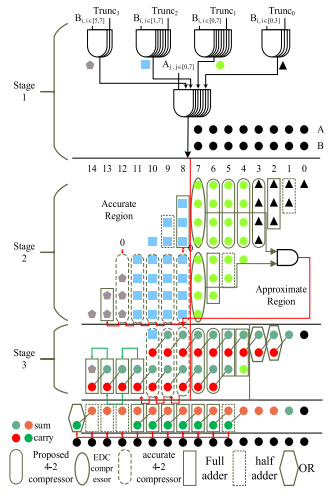
Block Diagram
Specifications
Software Requirements
FPGA Design Tools
· Xilinx Vivado Design Suite (2023.2 or later)
· Vivado Synthesis
· Vivado Implementation
· Vivado Simulator
Hardware Description Language
· Verilog HDL
Learning Outcomes
· Understand the fundamentals of approximate computing and sustainable AI hardware.
· Design LUT-based approximate multipliers using Verilog HDL.
· Learn static segmentation and Leading One Bit (LOB) detection techniques.
· Implement lightweight LUT-based error compensation mechanisms.
· Analyze FPGA and ASIC metrics such as area, power, energy, and delay.
· Evaluate image quality using PSNR and SSIM metrics.
· Analyze DNN inference accuracy using approximate arithmetic.
· Perform FPGA synthesis and ASIC implementation using industry-standard tools.
· Understand the trade-off between computational accuracy and energy efficiency.
· Develop energy-efficient arithmetic units for Edge AI and embedded systems.
· Gain practical experience in low-power VLSI design for neural network accelerators.
· Design sustainable hardware architectures for next-generation AI applications.


 Paper Publishing


Request Call Back
Would you like to receive a free callback now?
Choose the best time for callback:
Leave your message and we will contact you as soon as possible

6-2-85/B, Old Maternity Hospital Road, Thyagaraja Nagar, Tirupati, Andhra Pradesh – 517501
+91 9030333433
+91 9393939065
0877-2261612

Disclaimer - Takeoff Edu Group Projects are not associated or affiliated with IEEE in any way. The IEEE Projects mentioned here are mentioned in the context of student projects, whose ideas are derived from IEEE publications, not projects of or by IEEE.