Energy-Efficient Logarithmic Floating-Point Multipliers Using Truncation-Based Error Compensation for Fault-Tolerant Applications
Objective
The growing demand for energy-efficient computing in resource-constrained devices necessitates approximate arithmetic solutions that balance accuracy and hardware cost. This article presents a family of logarithmic truncation-based approximate multipliers (LTAMs) for floating-point (FP) operations, including two hardware cost-optimized architectures (LTAM1 and LTAM2) and an accuracy-focused lookup table (LUT)-based design (LTAM-LUT). All designs effectively address the systematic negative bias inherent in classical logarithmic multipliers through advanced error compensation methods
Abstract
The growing demand for energy-efficient computing in resource-constrained devices necessitates approximate arithmetic solutions that balance accuracy and hardware cost. This article presents a family of logarithmic truncation-based approximate multipliers (LTAMs) for floating-point (FP) operations, including two hardware cost-optimized architectures (LTAM1 and LTAM2) and an accuracy-focused lookup table (LUT)-based design (LTAM-LUT). All designs effectively address the systematic negative bias inherent in classical logarithmic multipliers through advanced error compensation methods. Based on a comprehensive analysis, a 6-bit mantissa truncation is identified as the optimal configuration. Under the 6-bit configuration, LTAM1-6 achieves 52.9% area and 77.6% power-delay product (PDP) reduction compared to conventional logarithmic approximate multipliers, while LTAM2-6 provides 45.1% area and 70.4% PDP reduction. LTAM-LUT achieves 56.4% accuracy improvement over conventional logarithmic approximate multipliers with a mean relative error distance (MRED) of 1.68%, the lowest among all compared designs. These hardware efficiency gains are also validated across diverse application domains. In HDR tone mapping, LTAM-LUT achieves up to 7.0 dB higher peak signal-to-noise ratio (PSNR) than conventional designs, while LTAM1-6 and LTAM2-6 provide 1.1- and 4.6-dB improvements, respectively. For single-image super-resolution (SISR) on DIV2K ( ×4 scale), LTAM-LUT preserves reconstruction quality nearly identical to exact arithmetic on HAT (29.73 dB) and achieves up to 2.3 dB higher PSNR than conventional logarithmic multipliers on EDSR, while LTAM1-6 and LTAM2-6 consistently outperform prior approximate designs across all tested architectures, demonstrating superior accuracy–efficiency tradeoffs for error-tolerant applications.
NOTE: Without the concern of our team, please don't submit to the college. This Abstract varies based on student requirements.
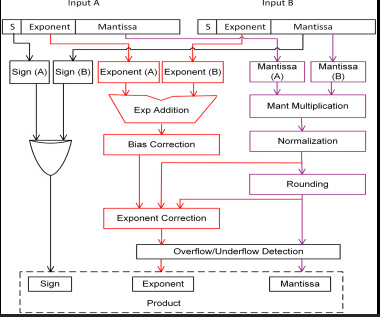
Block Diagram
Specifications
SOFTWARE REQUIREMENTS
• Xilinx
Vivado (optional FPGA implementation),Matlab 2020a
• Windows 10/11
• OpenCV Library
HARDWARE REQUIREMENTS
•
Intel Core i3 or above
• 4 GB RAM or higher
• Edge Device (Raspberry Pi/Jetson Nano)
• Camera Module
Learning Outcomes
· Understand the fundamentals of floating-point arithmetic and logarithmic multipliers.
· Learn truncation-based approximate computing techniques for energy-efficient arithmetic.
· Gain knowledge of hardware error compensation methods for reducing approximation errors.
· Understand fault-tolerant arithmetic circuit design.
· Learn FPGA and ASIC implementation of approximate multipliers.
· Analyze hardware performance using area, power, power-delay product (PDP), MRED, and PSNR metrics.
· Develop practical skills in low-power VLSI and approximate computing.
· Understand the application of energy-efficient multipliers in AI, image processing, and embedded computing systems..
· Understand AI-enabled healthcare systems for wearable and edge medical devices.


 Paper Publishing


Request Call Back
Would you like to receive a free callback now?
Choose the best time for callback:
Leave your message and we will contact you as soon as possible

6-2-85/B, Old Maternity Hospital Road, Thyagaraja Nagar, Tirupati, Andhra Pradesh – 517501
+91 9030333433
+91 9393939065
0877-2261612

Disclaimer - Takeoff Edu Group Projects are not associated or affiliated with IEEE in any way. The IEEE Projects mentioned here are mentioned in the context of student projects, whose ideas are derived from IEEE publications, not projects of or by IEEE.