An Accuracy-and-Efficiency-Configurable Blade-Type Approximate Multiplier with Genetic Algorithm-Based Automatic Training Framework
Objective
In artificial intelligence and image processing chips, the power consumption of arithmetic units has become a critical concern, motivating approximate techniques for higher efficiency. However, existing researches still face challenges in systematically and automatically exploring efficiency boundary under accuracy constraints. To address this, we propose a configurable blade-type approximate multiplier with a genetic algorithm based automated training framework. First, a blade type architecture is proposed for coarse accuracy and efficiency control, where Masks act like a “blade” to slice the partial-product array into multiple regions for localized truncation and compensation. Second, a data-correlation and error distribution based approximate compressor design method is used to achieve configurable compensation within each region for fine control.
Abstract
In artificial intelligence and image processing chips, the power consumption of arithmetic units has become a critical concern, motivating approximate techniques for higher efficiency. However, existing researches still face challenges in systematically and automatically exploring efficiency boundary under accuracy constraints. To address this, we propose a configurable blade-type approximate multiplier with a genetic algorithm-based automated training framework. First, a blade-type architecture is proposed for coarse accuracy and efficiency control, where Masks act like a “blade” to slice the partial-product array into multiple regions for localized truncation and compensation. Second, a data-correlation and error-distribution based approximate compressor design method is used to achieve configurable compensation within each region for fine control. Then, a genetic algorithm-based automated framework is designed to train dedicated compressors across all Masks in a multiplier, achieving inter-region error compensation and allowing automatic convergence toward the optimal efficiency -accuracy trade-off under different constraints and applications.8-bit and 16-bit blade-type multipliers achieve up to 31.0% and 37.7% power savings, and 39.8% and 51.6% PDP (Power-delay-product) gains, with only 13.98×10⁻⁴ and 14.08×10⁻⁶ NMED (Normalized mean error distance), respectively, compared to Design-Compiler baselines. When applied to image processing, the designs deliver up to 65.24dB PSNR (Peak Signal-to-Noise Ratio) and 60.67% power gain for smoothing, and 57.94dB PSNR with 62.98% power reduction for sharpening.
NOTE: Without the concern of our team, please don't submit to the college. This Abstract varies based on student requirements.
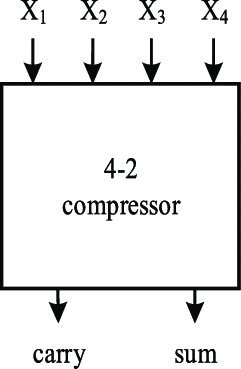
Block Diagram
Specifications
FPGA Design Tools
· Xilinx Vivado Design Suite (2023.2 or later)
· Vivado Synthesis
· Vivado Implementation
· Vivado Simulator
Hardware Description Language
Verilog HDLLearning Outcomes
· Understand the fundamentals of approximate computing for AI hardware.
· Design configurable blade-type approximate multipliers using Verilog HDL.
· Learn partial-product partitioning using configurable mask-based architectures.
· Develop data-correlation and error-distribution-based approximate compressors.
· Implement Genetic Algorithm (GA)-based automatic hardware optimization.
· Analyze hardware metrics including area, power, delay, PDP, and NMED.
· Evaluate image quality using PSNR in image processing applications.
· Understand adaptive optimization of hardware accuracy and efficiency.
· Gain practical experience in AI accelerator and Edge-AI hardware design.
· Develop low-power arithmetic units for sustainable computing systems.
· Build expertise in configurable VLSI architectures for next-generation artificial intelligence and image processing applications.




Request Call Back
Would you like to receive a free callback now?
Choose the best time for callback:
Leave your message and we will contact you as soon as possible

6-2-85/B, Old Maternity Hospital Road, Thyagaraja Nagar, Tirupati, Andhra Pradesh – 517501
+91 9030333433
+91 9393939065
0877-2261612

Disclaimer - Takeoff Edu Group Projects are not associated or affiliated with IEEE in any way. The IEEE Projects mentioned here are mentioned in the context of student projects, whose ideas are derived from IEEE publications, not projects of or by IEEE.